Key Takeaways
The three phases
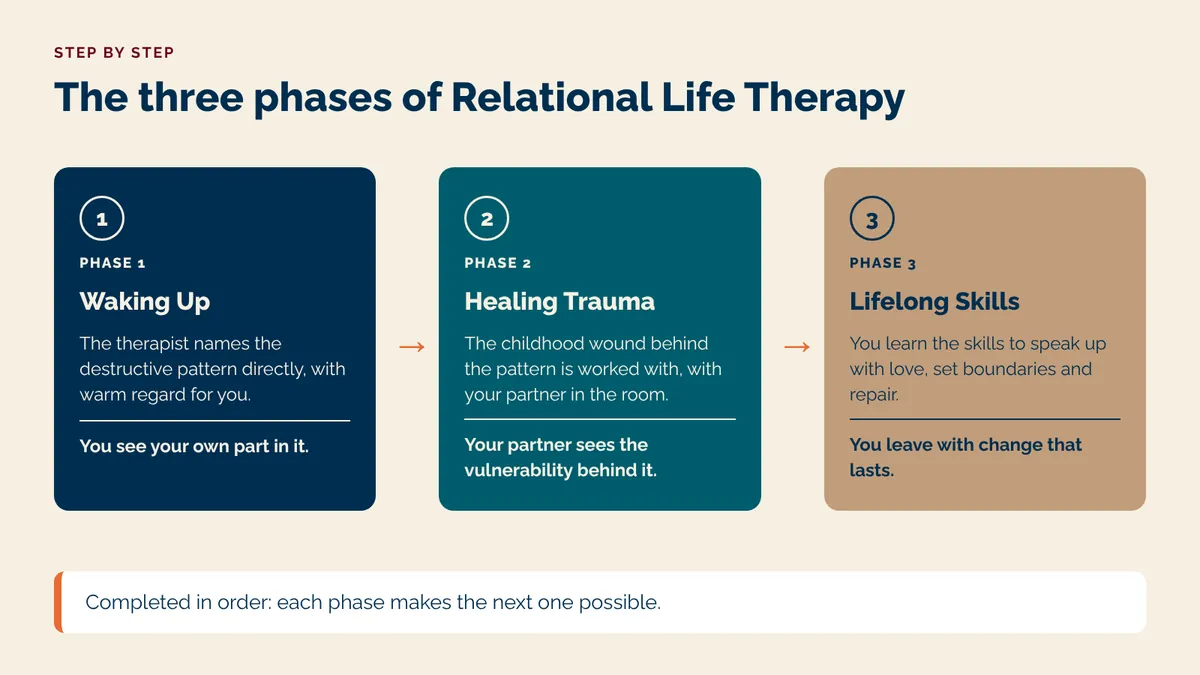
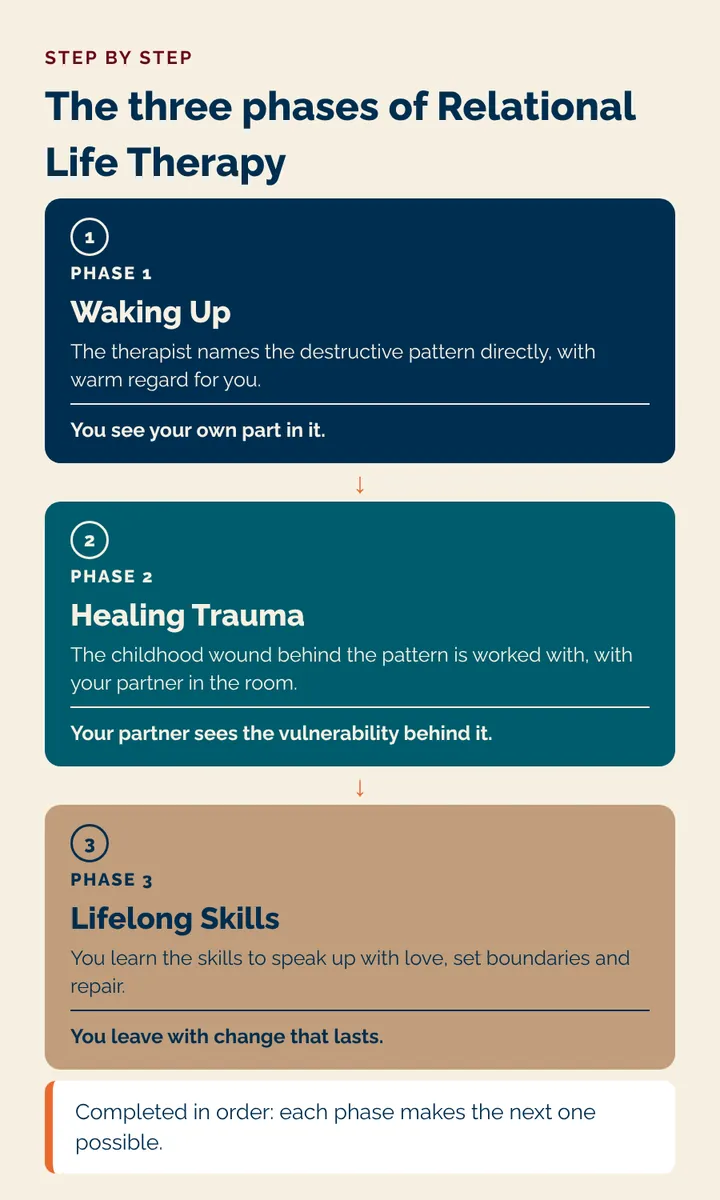
Relational Life Therapy moves couples through three phases in order: Waking Up, Healing Trauma, and Lifelong Skills.
Why the order matters
The therapist first names the destructive pattern, then heals the childhood wound driving it with both partners present, then teaches the skills that make change last.
Lovingly direct, not neutral
RLT therapists take sides against harmful behavior, not against the person, and confront it while holding each partner in warm regard.
What to expect
RLT sessions often run longer than a standard therapy hour, some practitioners offer one- or two-day Intensives, and RLT works with couples as well as with individuals on their own.
The three phases of Relational Life Therapy are Waking Up, Healing Trauma, and Lifelong Skills. Relational Life Therapy, the model I created, moves couples through these three phases in order: the therapist first names the destructive pattern directly, then heals the childhood wound driving it with both partners present, then teaches the relational skills that make the change permanent.
This guide walks through the three phases of Relational Life Therapy the way they unfold in the room: what the therapist does in each one, and what clients experience. If you are a therapist or coach, my 3-hour Couple Therapists Workshop teaches the three phases in depth and carries 3 NBCC CE hours.
What are the three phases of Relational Life Therapy?
Relational Life Therapy takes individuals and couples through three distinct phases:
- Waking Up – the therapist names what is going wrong, directly and compassionately.
- Healing Trauma – childhood wounds behind destructive behavior are worked with while the other partner is present.
- Lifelong Skills – the couple is taught the relational skills for lasting change and intimacy.
Skills cannot be taught to someone who does not yet believe there is a problem. And you can’t ask someone to drop a behavior without healing the wound that behavior protects. That’s why the three phases of RLT are completed in sequence, with each phase making the next one possible.
Watch from 10:48, where Terry starts explaining the three phases.
You may see the phrase “waking up, growing up, showing up” used elsewhere. That is the shorthand for what clients work on when they want to improve their relationship. The three phases of Relational Life Therapy – Waking Up, Healing Trauma, and Lifelong Skills – describe how a therapist guides that work. In clinical training you’ll also hear them called Waking Up the Client, Trauma Work, and Skill Building.
Phase 1 – Waking Up (Joining Through the Truth)
Waking Up is the first of the three phases of Relational Life Therapy. It is the moment a partner stops seeing themselves as the reasonable one, stuck in a fight with an unreasonable person, and sees their own part in the pattern.
The core clinical move in this phase is what I call “Joining Through the Truth.” The therapist lovingly names the destructive behavior (and what it’s costing them) and offers to help them change it, rather than staying neutral and confronting later. RLT therapists work beyond neutrality on purpose. Not every relationship problem is 50/50, and treating it as though it is leaves harmful behavior unchallenged. Where there are power imbalances in relationships, neutrality ends up protecting the dominant partner.
In RLT, we confront harmful behavior while holding the person in warm regard at the same time. Believing that behavior is connected to worth is toxic shame, and that is not healthy for the client or the relationship. Candid compassion allows us to take a direct approach to helping clients take accountability without collapsing into shame or defensiveness.
During this first phase, an RLT therapist will gather data through the Eight Diagnostic Lenses to identify the negative cycle the couple is stuck in. Part of this process includes mapping each partner’s stance (how each partner reacts in relationships under stress) on the Relationship Grid. Where each partner lands on the grid helps the therapist understand which of the Five Losing Strategies each of them reaches for. This can also surface each partner’s Core Negative Image of the other: the fixed, exaggerated image they have of their partner at their worst.
What Waking Up sounds like in session
Here is what that can sound like:
Therapist: Can I be honest with you about where you’re tripping yourself up?
Client: Yeah.
Therapist: The way you spoke to her just then – the cutting remarks, the sigh, the eye-roll – that’s contempt. You’re a decent man who’s been treating your partner poorly like this for years. How does it feel to hear that?
Client: Terrible. I love my wife; I don’t want to upset her.
Therapist: Will you let me help you?
Traditional therapy can spend months gathering history before ever confronting the real issue. RLT helps us get to the heart of what’s happening between the partners in the first phase of the work. The aim is for clients to feel deeply understood, clear about what needs to change, and hopeful for what’s possible.
Phase 2 — Healing Trauma (Inner Child Work)
Healing Trauma is the second of the three phases of Relational Life Therapy. This work is about understanding how the adult behavior that is harming the relationship now was, at some earlier point, an intelligent adaptation the client made as a child to protect themselves.
RLT therapy explains this through the three parts of the self:
- The Wise Adult – the client’s emotionally regulated self, grounded in the present, and capable of choosing a response that serves both the person and the relationship.
- The Adaptive Child – the part that learned strategies to survive childhood, like control, withdrawal, or people-pleasing.
- The Wounded Child – the youngest, most vulnerable part of a person, which carries the original hurt the Adaptive Child formed to protect against.
What makes RLT distinctive is that inner child work happens with the partner in the room. Usually, an RLT therapist will start by addressing the trauma of the partner whose protective stance is causing the most harm in the relationship – such as withdrawing in toxic shame, using unbridled self-expression, or controlling their partner.
This work aims to heal not only the old wound, but also the relationship around that wound. By tracing a behavior back to the family of origin, the partner can finally see the vulnerability behind it. Seeing the frightened child behind the shutdown or the criticism is often what turns contempt into compassion and empathy.
What Healing Trauma looks like for a couple
Here’s an example:
Imagine a client whose partner goes silent every time money comes up. The client has read it as stonewalling and carelessness.
In Phase 2, the client hears what happened in the partner’s childhood home when money came up: the shouting, the slammed doors, the blame. Back then, going quiet kept the partner safe, but that same protective strategy is what’s causing problems in the relationship today.
Addressing trauma here is not open-ended excavation. RLT therapy works to quickly identify and heal the specific adaptation driving the negative cycle of conflict between the partners. This work is what makes dramatic character change possible, and it starts by choosing new responses from the Wise Adult, which is where the third phase begins.
Phase 3 – Lifelong Skills (Skill-Building)
Building Lifelong Skills is the third and final phase of Relational Life Therapy. This is where lasting change is created by learning the minute-to-minute skills to repair conflict, cherish the connection, and sustain intimacy.
A core tool RLT therapists teach couples is the Feedback Wheel. This tool follows a clear four-step structure for raising a complaint without starting a fight: What I saw or heard, what I made up about it, how I felt about it, what I’d like.
The skills RLT teaches include:
- Relational mindfulness – catching oneself before reacting, remembering love, and choosing a response from the Wise Adult instead.
- Responsible time-outs – explaining why a break is needed, agreeing on a specific time to return, and returning regulated.
- Healthy boundaries – protecting oneself from a partner’s bad moments and containing oneself in one’s own.
- Speaking up with love – naming a hurt without blame using the Feedback Wheel, and asking for what one wants without contempt.
- Repair – coming back after a rupture to own one’s part, show compassion, and restore connection.
Underneath all RLT skills sits relational empowerment. Individual empowerment is about becoming stronger, protecting oneself, and getting one’s own needs met. Relational empowerment is about bringing that strength into connection, to work together and win as a team.
Learning these skills is the minute-to-minute work of relationships. That’s why RLT’s approach is action-oriented and gives couples homework between sessions to continue practicing skills in real time until they become automatic. Couples leave with a new shared language and the skills to handle conflict and live skilled relational lives.
How does Relational Life Therapy work in practice?
Here is how RLT sessions are typically structured and held.
How long is a Relational Life Therapy session?
Many RLT therapists run longer sessions than conventional couples therapy, so there is time to get to the heart of the pattern in a single meeting. Some practitioners also offer one- or two-day RLT Intensives as a concentrated and structured course of couples therapy. Session length and formats vary by practitioner and depend on the couple and their needs.
How long does RLT take?
RLT is designed to move faster than open-ended therapy. A therapist can usually give an estimate after the first phase. Many couples arrive at traditional therapy having asked, “How long does couples therapy take?” and been told, “As long as it needs.” RLT works toward a clear endpoint instead.
Do both partners have to come?
No. RLT is practiced with couples and also with individuals working on their own relational patterns. Individual work follows the same three phases, focused on how the client shows up with the people closest to them. Change in one partner is often all it takes to start shifting the dynamic between the two partners.
How the three phases of RLT differ from Gottman and EFT
Relational Life Therapy, Emotionally Focused Therapy (EFT), and the Gottman Method are three of the best-known couples therapy models. Here is how their structure, stance, and route to change compare:
| Relational Life Therapy | Emotionally Focused Therapy (EFT) | The Gottman Method | |
|---|---|---|---|
| Structure | Three phases: 1. Waking Up · 2. Healing Trauma · 3. Lifelong Skills | Three EFT stages: 1. De-escalation · 2. Restructuring Interactions · 3. Consolidation | Assessment, then work across the Sound Relationship House |
| Therapist stance | Lovingly direct, non-neutral | Humanistic, attachment-focused | Structured, coaching |
| Core mechanism | Naming the couple’s pattern, healing the wound beneath the behavior, teaching the skills to sustain intimacy | De-escalating the negative cycle, deepening emotional connection, and building on positive interactions | Building friendship and fondness, managing conflict, creating shared meaning |
| Where skills come in | Phase 3: Lifelong Skills | Throughout and consolidated in stage 3 | Throughout, via assessment-driven interventions |
| Created by | Terry Real | Sue Johnson | John and Julie Gottman |
All three approaches aim to strengthen the relationship, but they differ in emphasis, structure, and the route they use to create change. The stages of EFT couples therapy move a couple from de-escalating their negative cycle to rebuilding attachment security and consolidating their progress. Gottman therapists assess the relationship, then strengthen it level by level.
Relational Life Therapy takes a direct and non-neutral approach. Its therapists do not treat every conflict as equally shared, especially where there is a power imbalance. Instead, they take sides when one person’s behavior is causing more harm and challenge directly to restore balance.
Where the three phases came from
I first developed the core techniques of Relational Life Therapy through my Couples Intensive weekends with couples in 1998, and I have continued to develop and refine RLT over three decades of clinical practice. I’m a family therapist, author, and the founder of the Relational Life Institute.
The three phases draw on ideas explored across my books:
- I Don’t Want to Talk About It (1997)
- How Can I Get Through to You? (2002)
- The New Rules of Marriage (2007)
- Us: Getting Past You & Me to Build a More Loving Relationship (2022)
The Relational Life Institute was founded in 2008 and now trains and certifies RLT therapists and coaches worldwide. It teaches the Relational Life Therapy model to clinicians.
Underneath the model sits the analysis of psychological patriarchy: a hierarchy that places qualities culturally labeled masculine, such as control and independence, above those labeled feminine, such as vulnerability and connection. The essence of RLT is to help couples move out of patriarchy and into ecological wisdom by focusing on the relationship itself – not only on the two individuals receiving therapy side by side.
Is RLT too confrontational?
RLT is direct by design. RLT therapists do not aim for neutrality at all costs. They name what is damaging the relationship and take sides against the behavior, not the person.
The most common Relational Life Therapy criticism is that this directness risks shaming a client. That’s a fair concern, and it’s the reason the order of the phases isn’t negotiable. An RLT therapist always assesses before confronting and is never shaming, punishing, or driven by contempt.
Phase 1 names the behavior through loving confrontation. In Phase 2, the therapist helps clients understand where that behavior came from and heal the wounds behind it. A therapist who does the first without the second isn’t practicing RLT.
RLT therapists learn this compassionately direct, results-oriented method through a structured training and RLT Certification program run by the Relational Life Institute.
Does Relational Life Therapy work?
RLT grew out of clinical practice rather than a research lab. I developed its core techniques in my Couples Intensive weekends beginning in 1998, and the Relational Life Institute has trained and certified RLT therapists and coaches through its certification program since 2014. RLT combines psychotherapy, family systems thinking, trauma work, and neurobiology into one clear roadmap.
RLT has not yet been through formal outcome research. The Relational Life Foundation, a nonprofit that supports research, education, and awareness of RLT, is gathering data to build that evidence base. The research is still in progress, so I will not claim more for RLT than that.
Frequently asked questions
What is RLT therapy for couples?
Relational Life Therapy is the couples therapy model I created. It moves individuals and couples through three distinct phases: Waking Up, Healing Trauma, and Lifelong Skills. RLT is compassionately direct and takes sides against harmful behavior to rebalance the relationship rather than staying neutral.
How long does Relational Life Therapy take?
Relational Life Therapy is designed to move faster than open-ended therapy. Sessions are often longer than a standard therapy hour, and some practitioners offer one- or two-day RLT Intensives. A therapist can usually estimate the overall length after the first phase of work, once they understand the couple’s pattern.
Is Relational Life Therapy confrontational?
Yes, deliberately. RLT practices loving confrontation to name harmful behavior directly, then pairs it with inner child and trauma work to heal where that behavior came from. When one partner holds more power, neutrality protects dysfunction, so RLT therapists do not stay neutral.
Can RLT be done with one partner, without the other?
Yes. RLT is used with individuals working on their own relational patterns as well as with couples, so the partner does not need to be present for the work to begin. When one partner changes how they show up, the dynamic between both partners can shift, and some partners may choose to join later.
How is RLT different from Gottman or EFT?
RLT is known for its direct and non-neutral therapeutic stance. An RLT therapist will confront harmful behavior, then help heal what drives it. The RLT vs EFT vs Gottman comparison table in this guide sets out the differences in structure, stance, and mechanism between the couples therapy models.