Key Takeaways
What it is
The Relationship Grid is my diagnostic map from Relational Life Therapy (RLT). It plots self-esteem, from one-up grandiosity to one-down shame, against boundaries, from walled off to boundaryless.
The four quadrants
Its four quadrants – One-Up and Walled Off, One-Up and Boundaryless, One-Down and Walled Off, and One-Down and Boundaryless – describe the stances people take under relational stress.
A stance, not a personality
Your position on the grid is a stance, not a fixed trait. It can shift between conversations and relationships, and you can learn to return to the center of health.
How therapists use it
RLT therapists use the grid early in treatment to name a couple's pattern quickly, so both partners see their conflict as a shared pattern rather than one person's fault.
The Relationship Grid is a diagnostic tool I created as the founder of Relational Life Therapy that maps how people position themselves in close relationships. It plots self-esteem on a vertical axis, from one-up grandiosity to one-down shame, against boundaries on a horizontal axis, from walled off to boundaryless. The four quadrants it forms describe four common relational stances.
The Relationship Grid shows you your relational stance: the position you move into when your relationship is under stress. Also called the Terry Real Relationship Grid or the RLT Relationship Grid, it describes your relational stance, not your personality. Your position can shift from one conversation to the next and from one relationship to another, which means your stance is something you can learn to notice and change.
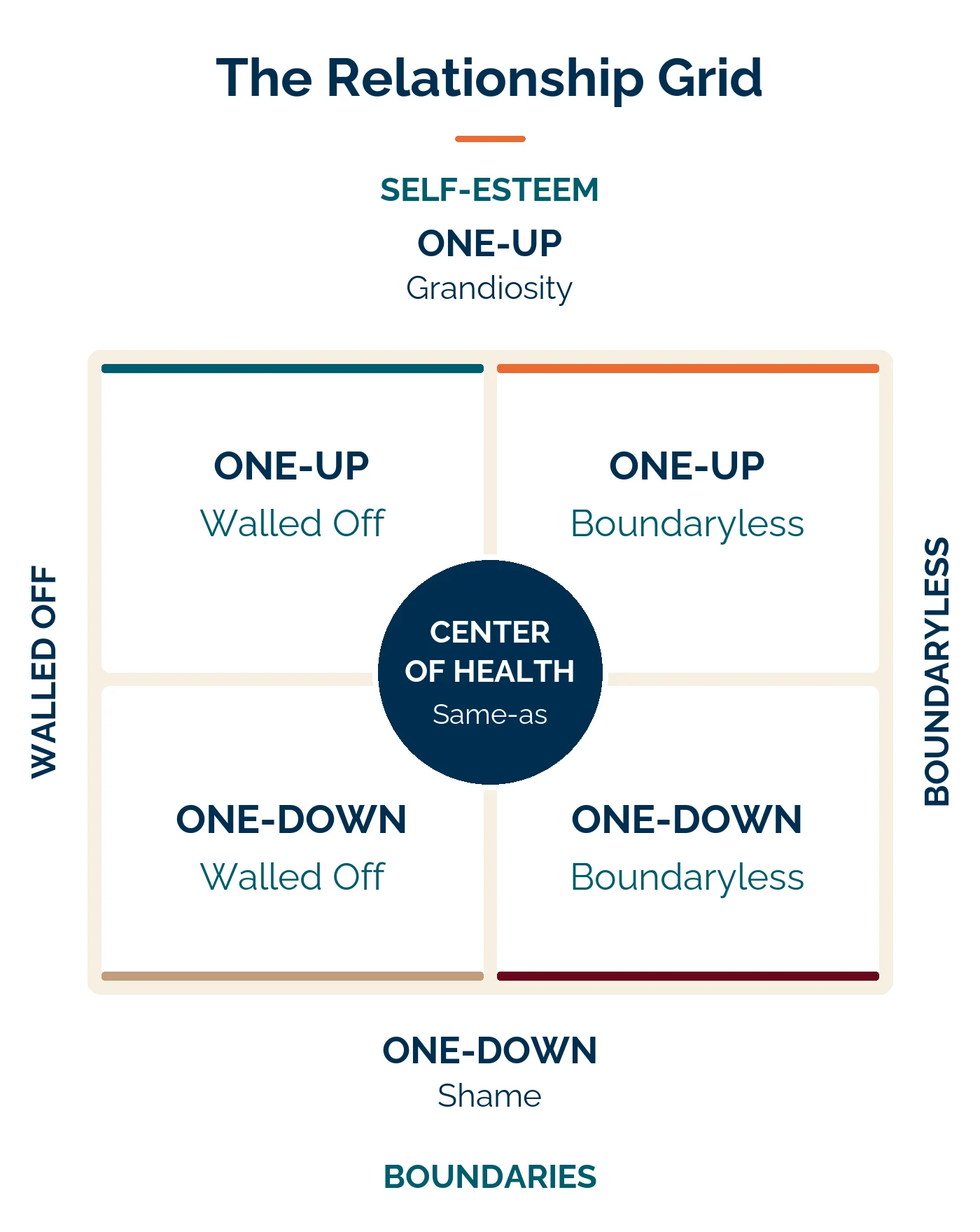
Therapists and educators are welcome to use this diagram with attribution and a link to relationallife.com.
What is the Relationship Grid?
The Relationship Grid is two intersecting axes that form four quadrants, with a healthy zone at the center where the axes cross. The vertical axis measures self-esteem. The horizontal axis measures boundaries. Every position on the grid combines the two: how you value yourself in relation to your partner, and how you manage what passes between you.
In Relational Life Therapy, the Relationship Grid is a diagnostic tool. An RLT therapist uses it early in treatment to name a pattern quickly, so a couple can stop arguing about the content of their fights and start working on the stances underneath them. Naming their stances is often the moment a couple sees their conflict as a shared pattern rather than one person’s fault.
Reading the grid comes down to two questions about any difficult moment:
- Am I treating myself as superior to my partner, or inferior to them?
- Am I shutting them out, or letting everything in?
The center is the goal, and the quadrants are where people go under stress. Nobody is locked into a quadrant, but most people have one they return to when they feel criticized, dismissed, or afraid.
The four quadrants of the Relationship Grid are:
- One-Up and Walled Off
- One-Up and Boundaryless
- One-Down and Walled Off
- One-Down and Boundaryless
Each quadrant describes a different way of protecting yourself in a close relationship. Each made sense at some point in your life, and each now costs you connection with the person you are trying to reach.
Who created the Relationship Grid?
I created the Relationship Grid. I’m a family therapist, the founder of Relational Life Therapy and the Relational Life Institute, which trains therapists and coaches in the RLT model.
I first made the Relationship Grid public in my 2007 book, The New Rules of Marriage: What You Need to Know to Make Love Work, and later featured it in Us: Getting Past You and Me to Build a More Loving Relationship. I’m also the author of I Don’t Want to Talk About It and How Can I Get Through to You?
My central argument is that healthy relationships require a shift from “you and me” thinking to thinking like a team. The Relationship Grid makes that idea visible, illustrating how people step out of “us” consciousness and into self-protection.
The grid’s structure sits in a recognized tradition. In 1957, psychologist Timothy Leary mapped interpersonal styles on a circular model known as the interpersonal circumplex. The Relationship Grid applies the same two-axis logic to intimate relationships.
The vertical axis: self-esteem, from one-up to one-down
In Relational Life Therapy, healthy self-esteem is the ability to hold yourself in warm regard from the inside, no matter what is happening outside. Your sense of worth doesn’t depend on external approval or achievement, and it doesn’t collapse when you make a mistake. I call this healthy position “same-as”: neither above nor below your partner.
The vertical axis measures how far a person moves away from “same-as” under stress. Move up and you reach one-up, also referred to as grandiosity. Move down and you reach one-down, also referred to as shame. This one-up, one-down relationship dynamic is at the heart of how I pair grandiosity and shame.
One-up (grandiosity) looks like entitlement, correction, and superiority. It is lecturing, keeping score, feeling above the rules, and the certainty that you are the “reasonable one.”
One-down (shame) looks like apology, collapse, and inferiority. It is “I’m the problem,” “I can’t do anything right,” feeling defective, unlovable, and taking excessive blame.
Here is the insight that matters most: shame and grandiosity are the same emotion facing different directions. Shame is contempt turned inward; grandiosity is contempt turned outward. Both are a failure to hold steady warm regard for yourself.
I use the term toxic shame for shame that has fused with identity. Healthy guilt says, “I’m a good person who did a bad thing.” Toxic shame says, “I did a bad thing. I’m a terrible person.” When shame takes over your whole sense of self, grandiosity becomes the escape hatch. That is why the same person can swing between both ends of the axis in a single argument.
A name for one version of that swing is “offending from the victim position.” A person feels hurt, small and wronged, and because that one-down position feels bad, they seek relief by behaving one-up. They begin to attack, punish or lecture, and they feel entirely justified, because in their own experience they are the injured party.
| One-Up (Grandiosity) | One-Down (Shame) |
|---|---|
| Corrects your account of events | Accepts excessive blame |
| Lectures and explains | Over-apologizes |
| Feels entitled to their anger | Feels undeserving of care |
| Keeps score of your failures | Keeps score of their own failures |
| Dismisses your feelings as overreaction | Dismisses their own needs as too much |
| “I’m the reasonable one” | “I’m the problem” |
The horizontal axis: boundaries, from walled off to boundaryless
In RLT, a boundary is not a rigid wall that keeps everything out. A healthy boundary is a permeable membrane that lets in what is useful and keeps out what is not. It also lets you share what matters while holding back what would do harm.
Healthy boundaries work in two directions:
- The protective boundary governs what you let in from your partner: their words, their moods, their judgments of you.
- The containing boundary governs what you let out toward your partner: your reactions, your anger, your impulse to say everything you feel the second you feel it.
Healthy boundaries in relationships need both.
Walled off means your boundaries are too rigid. Nothing can get in or out. It looks like emotional unavailability, stonewalling, withdrawal, “I’m fine,” leaving the room, and a partner who seems unreachable no matter how hard you try.
Boundaryless means your boundaries are too porous. Nothing gets filtered in either direction. It looks like enmeshment, absorbing your partner’s mood as your own, needing them to be okay before you can be okay, and saying whatever you feel the instant you feel it.
Walled off and boundaryless are both boundary failures. One is too closed, and the other is too open. Neither protects the relationship.
Few people fail in only one direction. A person can have a thick wall against criticism and no filter at all on their own anger: walled off on the way in, boundaryless on the way out.
The goal on this axis is flexibility: building boundaries strong enough to protect, and soft enough to let love in. That is a teachable skill, and it is the focus of RLI’s Better Boundaries course.
The four quadrants of the Relationship Grid explained
The two axes of the Relationship Grid intersect to form four quadrants. Each describes a distinct relational stance, and each makes sense as self-protection while coming at a cost to the relationship.
One-Up and Walled Off
One-Up and Walled Off is the stance of a partner who feels superior and stays out of reach, combining grandiose behavior with rigid boundaries.
What it looks like:
- Calm, cutting corrections that end the conversation
- Contempt expressed through silence, sighs, or eye-rolls
- Winning the argument by refusing to have it
- Refusing to engage with a feeling until it is “reasonable”
What it sounds like:
Jen: “Can we talk about last night? I felt really alone at that dinner.”
Mark: “You’re upset because you had too much wine. I’m not doing this.” (Mark picks up his laptop and goes to the study.)
What’s underneath: The One-Up and Walled Off partner fears being seen as flawed or needy. Superiority and distance protect them from the vulnerability of letting someone close. When this partner withdraws, it sends a clear message: “you are not worth engaging with.”
The move toward the center of health: Practice shifting from retreating into silence and superiority, toward engaging and getting curious (“Can you help me understand why you felt lonely?”) instead of ruling on whether the feeling is valid.
One-Up and Boundaryless
One-Up and Boundaryless is the stance of a partner who feels superior and has no filter, pushing into their partner’s space to manage, control, or fix.
What it looks like:
- Telling their partner what they’re really feeling
- Overriding their partner’s stated preferences “for their own good”
- Checking and managing their partner’s choices
- Unloading their emotions and feelings, and expecting their partner to absorb it
What it sounds like:
Priya: “I’d rather stay in this weekend. I’m exhausted.”
Sam: “You’re not exhausted, you’re anxious about seeing my family. You always do this. I already told them we’re coming.”
What’s underneath: The One-Up and Boundaryless partner fears losing control. If they can control and manage their partner, then they don’t have to sit with the discomfort of things not going their way.
The move toward the center of health: Building a containing boundary, making requests without demanding compliance, and respecting their partner’s right to say no.
One-Down and Walled Off
One-Down and Walled Off is the stance of a partner who is shame-based, feels “less than” or unworthy, and retreats into emotional distance when things become difficult.
What it looks like:
- Absorbing criticism and feeling resigned
- Withdrawing for hours or days after conflict
- Struggling to voice their own needs
- Being read by their partner as cold or avoidant
What it sounds like:
Anna: “I felt like I was handling everything on my own tonight.”
Luis: “I know. I just never seem to get it right.” (Luis looks down and goes quiet. When Anna asks what he’s thinking, he says, “Nothing.”)
What’s underneath: The One-Down and Walled Off partner fears that nothing they do will ever be good enough. They make themselves hard to reach as a way to protect themselves from criticism or rejection.
The move toward the center of health: Learning to lean in, speak up with love, hold yourself in warm regard, and take proportionate responsibility without collapsing into worthlessness.
One-Down and Boundaryless
One-Down and Boundaryless is the stance of a partner who is shame-based and placates and pursues their partner until connection feels secure again.
What it looks like:
- Over-apologizing or taking responsibility for more than is theirs
- Seeking reassurance repeatedly or urgently
- Being dependent on their partner’s love and approval
- Pursuing harder the more their partner pulls away
What it sounds like:
Chris: “I need some quiet time tonight. We’re fine, I’m just tired.”
Tom: “Are you sure? I’m sorry if I’ve upset you. Please tell me what I did.”
What’s underneath: The One-Down and Boundaryless partner fears being left alone, disconnected, or unlovable. They often put their partner’s needs and feelings ahead of their own, and pursue harder when their partner pulls away in an attempt to restore closeness.
The move toward the center of health: Building a protective boundary, letting their partner’s feelings belong to their partner, and self-soothing instead of repeatedly seeking reassurance.
Most people have a home quadrant they fall into under stress, though their stance can change depending on the person or situation. For example, someone who is One-Down and Boundaryless with a spouse can be One-Up and Walled Off at work.
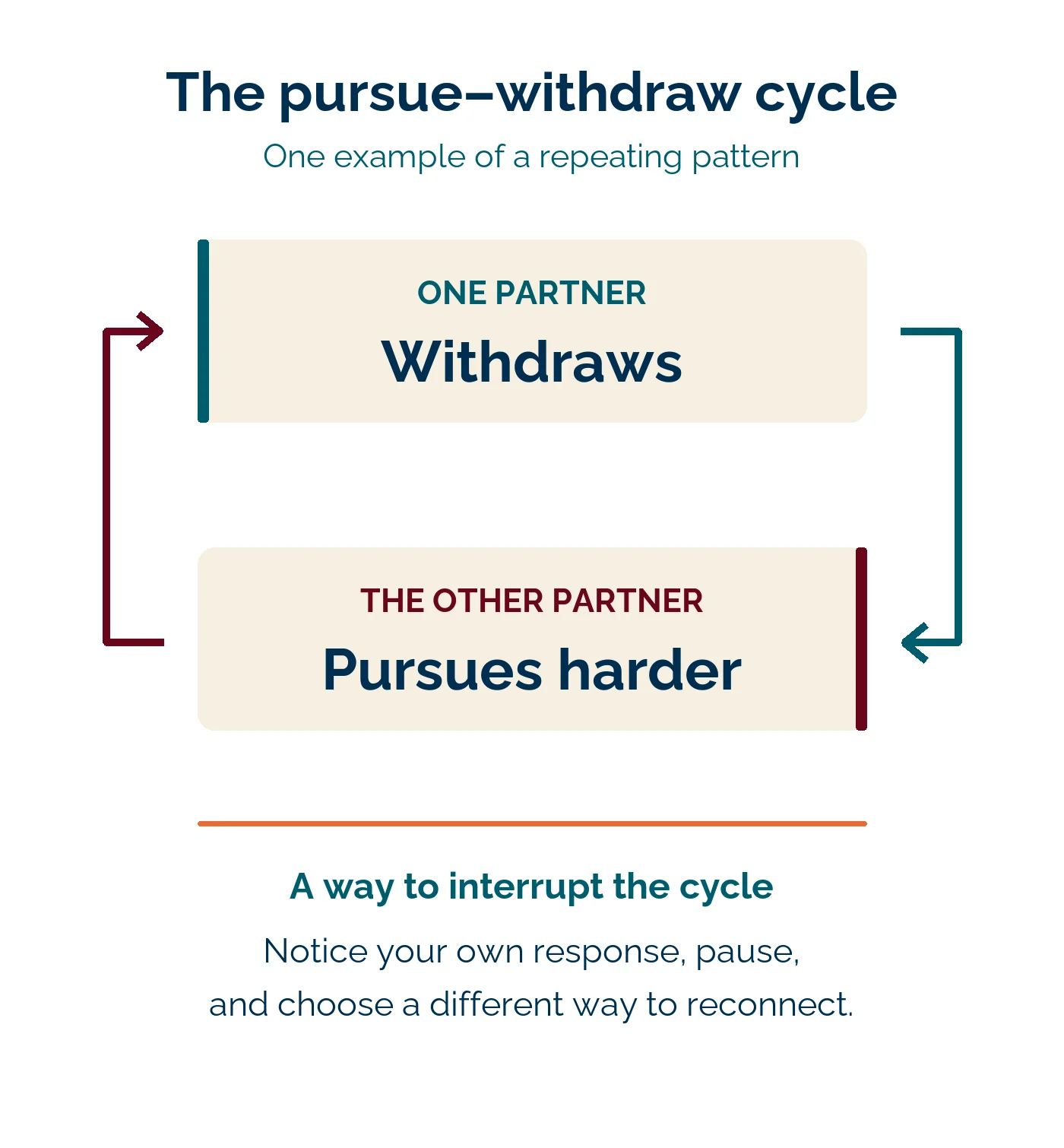
Couples often lock into complementary patterns where each stance provokes the other. For example, when a One‑Up and Walled Off partner pairs with a One‑Down and Boundaryless partner, the more one pursues, the more the other withdraws – and the more one withdraws, the more the other pursues.
Seeing both stances on the grid helps each partner recognize their part in creating the cycle they’re stuck in, and what they can each change to break it.
| Quadrant | Self-esteem position | Boundary style | What it looks like | The move toward center |
|---|---|---|---|---|
| One-Up and Walled Off | Grandiose | Rigid | Correction, contempt, withdrawal | Engaging and getting curious |
| One-Up and Boundaryless | Grandiose | Porous | Control, intrusion, unbridled self-expression | Containing reactions and making requests |
| One-Down and Walled Off | Shame-based | Rigid | Collapse, silence, withdrawal | Speaking up with love and holding yourself in warm regard |
| One-Down and Boundaryless | Shame-based | Porous | Placating, over-apologizing, pursuing | Building healthy self-esteem and self-soothing |
What does the center of the Relationship Grid mean?
The center of the Relationship Grid is where both axes are in balance: healthy self-esteem and supple boundaries. You are neither above nor below your partner, neither walled off nor boundaryless. RLT calls this zone the center of health.
At the center of health, you are “same-as.” You hold yourself and your partner in warm regard at the same time. You can hear a complaint without collapsing or counterattacking, and you can say what you need without demanding it or apologizing for it.
In calmer, well-regulated moments, we may be at the center. But under relational stress or in conflict, all of us can slip into a familiar quadrant. The goal is to be able to notice when you’ve drifted and know how to return to the center.
RLT calls that way back repair, and it requires you to recognize your own stance, and choose a more relational move to reconnect after rupture. With practice, you can catch your reactions sooner, and find your way back to each other more readily. RLT teaches the relational skills that make this possible.
How do I find my position on the Relationship Grid?
Think back to a difficult conversation with your partner and ask yourself:
- Did I feel certain I knew better, or did I feel like the problem was me?
- Did I shut my partner out, did I try to control the situation, or rush to restore closeness?
- What was the fear I was trying to protect myself from?
Reflect on a few different conversations to help you locate which quadrant you tend to return to under stress. For a more in-depth analysis, take the free Relationship Grid Assessment from the Relational Life Institute. The Terry Real Relationship Grid quiz identifies your relational stance and how to return to health at the center.
If you’re in a relationship, ask your partner to take the assessment too, so you can compare your results and see how your two stances interact.
It’s important to note that your result describes where you go under stress now, not a fixed identity or character flaw. These are patterned reactions learned in childhood and triggered in adulthood – and you can learn new ways to respond that build closeness today.
Is the Relationship Grid backed by research?
Research on the Grid Assessment, the questionnaire used to map a person’s relational stance on the Relationship Grid, is still at an early stage. The Relational Life Foundation lists a Relationship Grid Study among its research projects, but its research page doesn’t yet report findings.
The Relationship Grid is a clinically oriented assessment tool, rather than a personality-type quiz. The assessment asks people to rate how much they recognize particular relationship behaviors, especially during conflict. This can help practitioners identify recurring patterns of self-protection and how those patterns affect connection.
For couples, the Relationship Grid offers a structured, clinically informed way to understand their conflict patterns and how their responses interact.
How the Relationship Grid fits into Relational Life Therapy
In Relational Life Therapy, the RLT Relationship Grid is one of the Eight Diagnostic Lenses that RLT therapists apply early in treatment to name a couple’s relational pattern quickly, often from the very first session.
Your placement on the grid also helps predict which of the Five Losing Strategies you use in conflict: needing to be right, controlling your partner, unbridled self-expression, retaliation, and withdrawal. These strategies are not fixed to a grid position. The same strategy can show up in different quadrants and serve different protective purposes.
For example, retaliation often starts one-down, with a sense of injury, and turns one-up when we feel entitled to hurt our partner in return.
Withdrawal from One-Down and Walled Off can mean, “Nothing I do will be good enough, so I’ll disappear.” From One-Up and Walled Off, it can mean, “You’re not even worth engaging with.”
These repeated responses can also reinforce your Core Negative Image: the fixed, worst-case picture you and your partner carry of each other. When you return to a familiar stance under stress, your partner may see it as confirmation of that picture.
Recognizing the stance beneath the behavior helps you understand what you’re protecting yourself from and what you need to practice differently. In RLT terms, these protective reactions come from the Adaptive Child – the part of you that learned how to protect yourself in childhood. The work is to access the Wise Adult part of you, who is capable of pausing, remembering love, and choosing a more relational response.
That change is supported by the second and third phases of the three phases of RLT: trauma work and relational skill building. One practical tool outside of treatment you can use is the Feedback Wheel, which gives you the step-by-step structure to speak from the center of health.
It’s worth noting that the Relationship Grid is sometimes mistaken for an attachment-style framework. It is not. Attachment styles describe how people seek closeness and safety in relationships – often shaped by early caregiving that can continue to evolve through adult experience. The Relationship Grid maps a person’s relational stance under stress, which can shift across relationships, situations and sometimes even within a single difficult conversation.
In this video, I introduce the Relationship Grid as a diagnostic tool mapping the intersection of self-esteem and boundaries. I explain how it helps therapists quickly identify where each partner is positioned – and how those positions combine to create the couple’s “dance.”
Frequently asked questions about the Relationship Grid
What is the Relationship Grid?
The Relationship Grid is Terry Real’s diagnostic map of the stances we take under relational stress. Developed within Relational Life Therapy, it uses two intersecting axes: self-esteem (from one-up to one-down) and boundaries (from walled off to boundaryless) to create four quadrants. Each quadrant describes a relational stance, with healthy self-esteem and boundaries at the center.
What are the four quadrants of the Relationship Grid?
The four quadrants are One-Up and Walled Off (grandiose and love avoidant), One-Up and Boundaryless (grandiose and love dependent), One-Down and Walled Off (shame-based and love avoidant), and One-Down and Boundaryless (shame-based and love dependent). Most people have a familiar quadrant they return to under stress, though their stance can shift with different people and situations.
What does one-up and one-down mean in a relationship?
In Terry Real’s work, one-up means grandiosity: feeling better than, dismissing, and holding your partner in contempt. One-down means shame: feeling less than, collapsing, and holding yourself in contempt.
The healthy alternative that true intimacy requires is being “same-as”: holding yourself and your partner in equal worth – neither above nor below one another.
What is the difference between being walled off and boundaryless?
Walled off means boundaries that are too rigid: nothing can get in or out, so you become emotionally unreachable.
Boundaryless means boundaries that are too porous: you struggle to filter what you take in from your partner or contain your own reactions.
Both are boundary failures. Healthy boundaries are flexible: firm enough to keep yourself and others protected, open enough to stay connected.
Can you change your position on the Relationship Grid?
Yes. Your position on the Relationship Grid is a stance you take under stress, not a fixed personality trait. It can shift with circumstances and with the person you’re with.
In Relational Life Therapy, couples learn to recognize their familiar home quadrant, and develop the skills to move back toward the center of health. That capacity grows with practice and is central to our relational work.
Is there a Relationship Grid quiz or assessment?
Yes. The Relational Life Institute offers a free Relationship Grid Assessment. It asks how you react in conflict to identify your primary relational stance and offers guidance on returning to the center of health.
Every quadrant of the Relationship Grid began as a way to protect yourself. The center of health is where protection and connection meet in harmony.
If you want to find out your relational stance, take the free Relationship Grid Assessment. If you’re ready to do this work with support, find an RLT-certified therapist trained in the RLT model.