Key Takeaways
What they are
The Five Losing Strategies are the five conflict habits in Relational Life Therapy (RLT): needing to be right, controlling your partner, unbridled self-expression, retaliation, and withdrawal.
Why couples keep using them
Each strategy tries to meet a real need, such as being heard or feeling safe. It brings short-term relief but costs the connection both partners want.
What works instead
RLT pairs them with the Five Winning Strategies, such as shifting from complaint to request and speaking up with love. Together they give couples and their therapists a shared, practical language for repair.
Stonewalling vs. a time-out
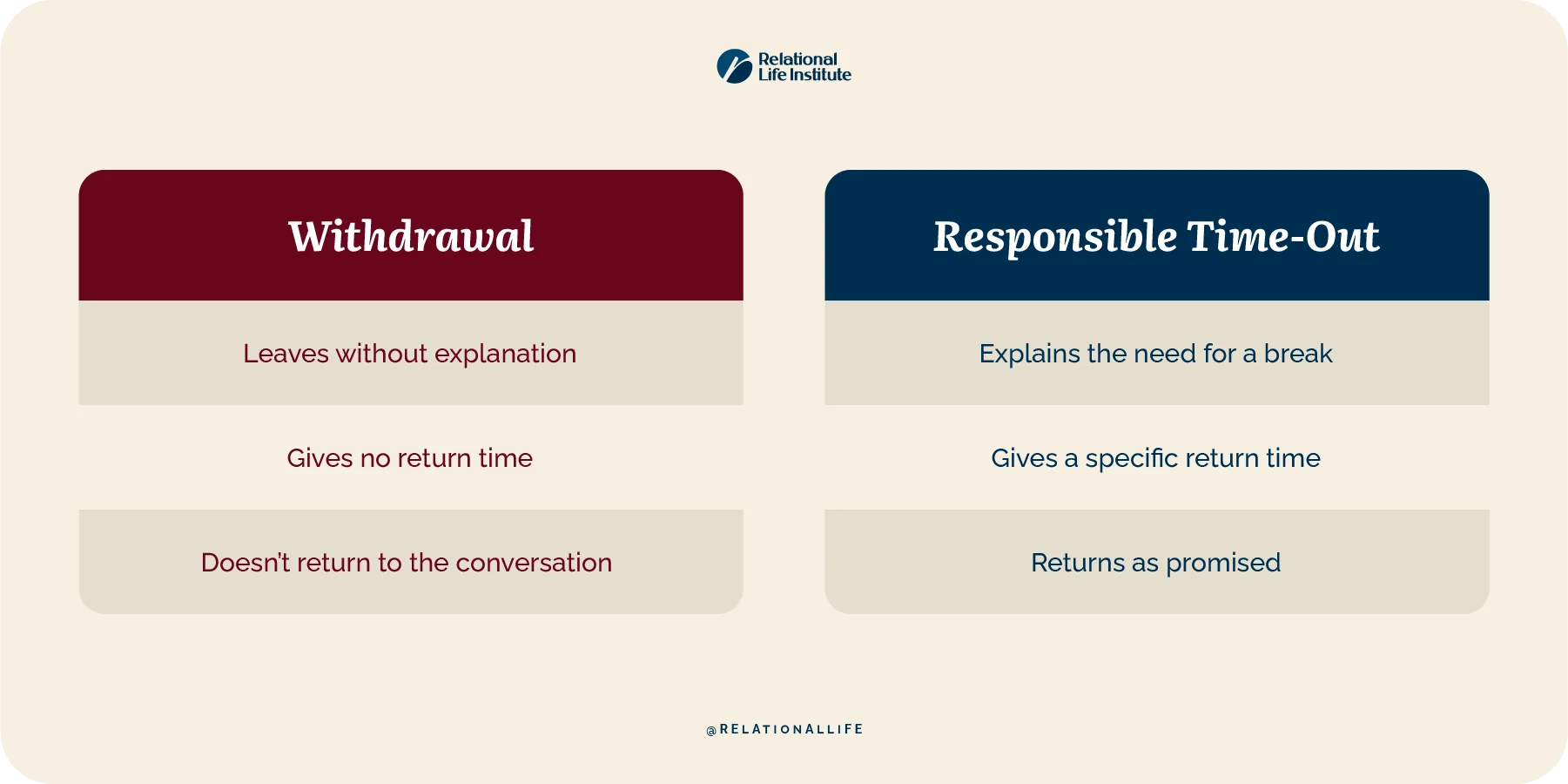
Withdrawal includes stonewalling. A responsible time-out is different: you explain the break, name a return time, and come back when you said you would.
The Five Losing Strategies are the five conflict habits in Relational Life Therapy as the reason couples fight without resolving anything. I name them in my book, The New Rules of Marriage (2007): needing to be right, controlling your partner, unbridled self-expression, retaliation, and withdrawal. Each one feels justified in the moment, and each one costs you connection.
You may recognize these habits in arguments with your partner. You want them to understand how you feel, yet the way you’re trying to get through makes it harder for them to listen.
Sam: “You’re always on your phone. You never listen when I’m talking.”
Alex: “All you ever do is complain. Maybe I’d want to talk to you if you stopped criticizing me.”
Sam’s wish to spend time together gets lost as each tries to prove the other is being unfair. Ten minutes later, they’re arguing about who remembers last Christmas correctly.
They’re having the same argument over and over, only in a different costume each time.
Most people focus on the topic of conflict, but what really matters are the moves each partner makes under stress that keep you locked in it. Relational Life Therapy calls them the Five Losing Strategies, and they sit beneath most unhealthy relationship patterns and communication problems in relationships.
This guide covers what the Five Losing Strategies are, what drives them, and what to do instead – whether you’re stuck in the same fight with your partner, or you’re a therapist or coach helping couples out of it.
What are the Five Losing Strategies?
The Five Losing Strategies are:
- Needing to Be Right – insisting your version of reality is correct and making the conversation about proving it.
- Controlling Your Partner – trying, directly or indirectly, to make your partner think, feel, or do something they have not chosen.
- Unbridled Self-Expression – saying everything you feel or think without regard for timing, regulation, proportion, or impact.
- Retaliation – hurting your partner back, openly or quietly, so they feel what you felt.
- Withdrawal – shutting down and leaving the room, the conversation, or the relationship emotionally out of resignation or punishment.
I first introduced the Five Losing Strategies in my 2007 book The New Rules of Marriage: What You Need to Know to Make Love Work. As a psychotherapist and founder of the Relational Life Institute, I still teach them as a core part of Relational Life Therapy, and I explore them further in my book Us: Getting Past You and Me to Build a More Loving Relationship (2022).

Losing Strategies in Relationships
- Needing to be right
- Controlling your partner
- Unbridled self-expression
- Retaliation
- Withdrawal
Winning Strategies in Relationships
- Shifting from complaint to request
- Speaking up with love
- Responding with generosity
- Empowering each other
- Cherishing
@relationallife
Why do the losing strategies feel so justified?
Each of the Five Losing Strategies is an attempt to meet a legitimate need, but pursued through a self-defeating method.
Relational Life Therapy calls the part of you that grabs these moves the Adaptive Child: the part that learned how to protect yourself growing up, using the best options available at the time. The Wise Adult is the grounded, grown-up you who can recognize when you’re triggered and choose a response that cares for both you and your relationship.
| What you want | What you reach for | What you actually get |
|---|---|---|
| To be seen as reasonable | Needing to Be Right | A partner who feels dismissed |
| Safety and predictability | Controlling Your Partner | Resistance and resentment |
| To be heard | Unbridled Self-Expression | A partner who stops listening |
| Justice for the hurt | Retaliation | Escalation |
| Relief from overwhelm | Withdrawal | A partner who pursues harder, then gives up |
The trap is that the losing strategies often work in the short term. Winning an argument can feel validating, getting your way can ease your anxiety, shutting down can bring relief from overwhelm. That immediate payoff helps explain why you keep reaching for them, even when they damage the connection you want.
And when they don’t work, instead of blaming the strategy, we blame our partners and reach for it again, hoping for a better outcome next time.
The strategy you reach for can also reflect where you stand in the moment of conflict: whether you’re looking down on your partner or feeling less worthy than them.
1. Needing to Be Right
Needing to Be Right is the losing strategy of insisting your version of reality is correct and making the conversation about proving it.
This losing strategy turns a conversation about feelings into a trial over facts and whose position is justified. In a culture that rewards being right, it can feel like a virtue – but when proving your point matters more than understanding your partner, it will always cost you intimacy.
What does needing to be right look like in a relationship?
- You re-litigate the facts: who said what, when, and in what tone.
- You hear yourself say, “That’s not what happened.”
- You collect evidence before you’ve said how you feel.
- You insist their feelings are invalid because their account is “wrong.”
- You treat concession as defeat.
Here’s how this might play out:
Maya: “You made fun of me in front of everyone at dinner.”
Dan: “That’s not what happened. I told one funny story. Everyone was laughing, including you.”
Maya: “I was embarrassed. And Sarah said she thought you were being mean, too.”
Dan points to everyone’s laughter to defend himself, while Maya brings in Sarah’s opinion to support her case. Her hurt goes unaddressed as the conversation becomes about who’s right. No matter who wins the argument, the relationship loses.
Underneath the need to be right in a relationship is the desire to be seen as reasonable in the search for validation, not truth. As I often tell the couples I work with:
“You can be right, or you can be married. What’s more important to you?”
What to do instead of needing to be right
The winning strategy is Shifting from Complaint to Request. Stop arguing about what went wrong in the past and ask for something specific that you would like in the future.
Use this sentence structure:
“When you [Specific Behavior], I feel [Feeling]. What I’d like is [Specific, Behavioral, Reasonable Request].”
Here is the structure in use: “When you told everyone about my mistake at work, I felt embarrassed. What I’d like is for you to check with me before sharing a story like that.”
For a fuller version, use the Feedback Wheel, RLT’s four-step script for turning a complaint into a request:
- What I saw or heard – the facts of one event, as a camera would have recorded them.
- What I made up about it – the story you told yourself about what happened.
- How I felt about it – your feelings, not your thoughts.
- What I’d like – a specific request that would help you feel better.
2. Controlling Your Partner
Controlling Your Partner is the losing strategy of trying, directly or indirectly, to make your partner think, feel, or do something they have not chosen.
What is controlling behavior in a relationship?
Controlling behavior in a relationship is any attempt to manage another adult’s choices instead of your own.
Direct control is out loud: telling, demanding, threatening, managing.
Indirect control is quieter: guilt-tripping, sulking, withholding warmth until your partner falls in line, or helpfulness with strings attached.
Whether you’re the controlling partner or living with one, signs of controlling behavior in a relationship include:
- You redo tasks your partner has already done, “properly.”
- You decide how they should feel, then argue when they don’t.
- You track their time, spending, or messages.
- You go cold until they agree with you.
- You use your mood as leverage.
The need underneath is safety and predictability. When life with another person feels uncertain, controlling them feels like controlling the uncertainty.
A note on safety: a controlling habit in an otherwise safe relationship is different from coercive control, a sustained pattern of intimidation, isolation, or threats that leaves a partner afraid. If you feel unsafe with your partner, contact the National Domestic Violence Hotline or a qualified professional.
What to do instead of controlling your partner
You cannot control your partner. You can control what you ask for and how you respond.
Make a clear, loving, and specific request and let your partner choose their response. A request leaves room for a “no,” even when that’s disappointing.
Then, practice healthy boundaries in both directions: what you take in and what you put out. You can let your partner be disappointed without feeling you have to give in. You can also handle your own disappointment without pressuring them to do things your way.
3. Unbridled Self-Expression
Unbridled Self-Expression is the losing strategy of saying everything you feel or think without regard for timing, regulation, proportion, or impact.
Many of us were taught that when we’re upset, the healthiest thing is to get it all out. Saying exactly what’s on your mind can feel honest and necessary, but venting your complaints can leave your partner focused on defending themselves rather than understanding what’s hurting you.
You may feel some relief after unloading, but permitting yourself to say everything you feel only leaves you with more hurt to repair.
Here is the same grievance, delivered twice.
Unbridled: “You never think about anyone but yourself. You booked the whole weekend with your friends even though we had plans. You’re exactly like your father.”
With the Feedback Wheel: “You booked to go away this weekend with your friends, and what I made up is that our time together wasn’t important to you. I felt hurt. What I’d like is for us to check in with each other before committing to a weekend away.”
The first version attacks your partner’s character, while the second explains what upset you and gives them a specific request they can respond to.
The need underneath this losing strategy is to be heard. The irony is that unbridled self-expression is the surest way to not be heard.
What to do instead of unbridled self-expression
The winning strategy is Speaking Up with Love. Say the hard thing, and say it in a way your partner can actually take in: with respect and with repair as the goal. The RLT Feedback Wheel offers a step-by-step structure to help you do this.
4. Retaliation
Retaliation is the losing strategy of hurting your partner back, openly or quietly, so they feel what you felt. I call it “offending from the victim position”: feeling justified in making them feel the pain you feel while seeing yourself as the wronged party.
Overt retaliation is visible: a raised voice, matching insult, copied behavior.
Covert retaliation is passive aggression: withholding affection, “forgetting” the thing that mattered to them, sarcasm, sexual withdrawal. Passive-aggressive behavior in relationships is retaliation that keeps its hands clean.
Jordan: “You forgot my work dinner.”
Casey: “Did I? Funny. You forgot my birthday last week.”
Casey has a point about the birthday. But now there are two injuries on the table, and nobody is tending to either one.
Retaliation in relationships often draws on your Core Negative Image – the worst-case story you carry about your partner. If you’ve decided they’re selfish or uncaring, punishing them in these moments can feel deserved.
Underneath retaliation is often a wish for your pain to be acknowledged and for your partner to take responsibility.
What to do instead of retaliating
Name the hurt directly, and ask for repair: “I was really hurt that you didn’t do anything for my birthday. Could we plan something to celebrate, and talk about which occasions matter most to each of us?”
If you aren’t ready to talk yet, say that honestly: “I’m hurt, and I need an hour before I can discuss it.” Then come back and have the conversation.
5. Withdrawal
Withdrawal is the losing strategy of shutting down and leaving the room, the conversation, or the relationship emotionally out of resignation or punishment. Emotional withdrawal in relationships has a more common name: stonewalling.
What is stonewalling in a relationship?
Stonewalling in a relationship is shutting down during conflict and refusing to engage. The stonewaller goes silent, gives one-word answers, leaves the room, or says “I’m fine” when they are not. They retreat behind a wall.
Signs of stonewalling include a blank face, giving minimal answers, using your phone or television as a distraction, changing the subject, and days of polite distance. It overlaps with the silent treatment in relationships, but the intent differs: stonewalling protects a partner who feels overwhelmed, while the silent treatment is meant to punish.
Stonewalling in marriage often begins with emotional flooding: your heart rate spikes, fight-or-flight takes over, and you cannot think clearly. In these moments, shutting down feels like survival. Many stonewallers learned it in childhood, in homes where silence was how conflict got handled. Relational Life Therapy treats it as a move you learned, which means you can unlearn it.
For the partner on the receiving end, this silence can feel like abandonment. They may push harder for a response, prompting the other partner to withdraw further. This pursuer–distancer loop is how chronic stonewalling patterns form, and the Gottman Institute names it as one of four behaviors that predict divorce.
However, stonewalling does not automatically mean your relationship is over. It simply signals a pattern that needs attention.
Stonewalling vs. taking a time-out
A responsible time-out has three parts: an explanation for why you’re stepping out, a specific promise of when you’ll return, and coming back when you said you would. Stonewalling fails at least one of those conditions.
Taking time-outs is healthy; disappearing without communication is destabilizing and puts intimacy at risk.
Is stonewalling abuse?
Shutting down once during an overwhelming fight is not abuse. Chronic, deliberate, prolonged stonewalling used to punish or control a partner can be emotionally abusive. The test is intent and pattern: is the silence protecting someone who is overwhelmed, or is it being used to make the other person suffer until they give in?
How to respond to stonewalling
- Stop pursuing. Pursuing harder guarantees more withdrawal.
- Name it once, without attack. “It looks like you’ve shut down. I’d like to finish this when you’re ready.”
- Calm your own body. You are emotionally flooded too. Take a break, breathe, and regulate yourself until your heart rate drops.
- Agree on a time-out plan later. Set the rules when you’re both calm, not mid-fight.
The need underneath withdrawal is safety and relief from overwhelm, but over time it erodes safety, trust, and connection.
How to stop stonewalling
Take a responsible time-out, and say it out loud:
“I’m too overwhelmed to do this well. I’m going to take a twenty-minute walk to calm myself down, then I’ll come back at 3pm, and we can talk about this.”
Use the time-out for self-soothing and de-escalation, not to rehearse your case. Then come back. That is how to stop stonewalling.
The Five Winning Strategies: what to do instead
The Five Winning Strategies are what we teach in RLT in place of the losing ones: the moves that help you succeed in the critical tasks of getting, giving, and having – without losing connection.
- Shifting from Complaint to Request – identify what would work better for you, and ask for it in a way that is specific, behavioral, and reasonable.
- Speaking Up with Love – share your experience or feedback with loving firmness to make things better between you.
- Responding with Generosity – when your partner raises a concern, listen to understand, acknowledge your part, and give what you reasonably can.
- Empowering Each Other – actively work together as a team to help your partner succeed with you for the good of the relationship.
- Cherishing – practice regular appreciation for what your partner already gives you through specific and positive feedback.
Relational Life Therapy describes every relationship as moving through harmony, disharmony, and repair. Disharmony is normal. The losing strategies are what keep you stuck in it; the winning strategies are what help you find your way back to each other.
Underneath all five is what RLT calls full-respect living: the practice of treating yourself and your partner with respect as “same-as” equals – especially during conflict.
If you want to know how to stop arguing with your partner, this is the practical answer. You don’t need to stop an argument by avoiding it; you just need to change what you do inside it. The RLT Feedback Wheel is the most concrete place to start: watch this video of me explaining how it works.
Five Losing Strategies vs. Gottman’s Four Horsemen: what’s the difference?
Julie and John Gottman’s Four Horsemen – criticism, contempt, defensiveness, and stonewalling – emerged from observational research on couples at the University of Washington. The Five Losing Strategies grew out of my clinical practice with couples, and I published them in The New Rules of Marriage (2007) as the core relational patterns that undermine intimacy.
4 Horsemen (Gottman) vs. Five Losing Strategies (RLT)
| Four Horsemen (Gottman) | Five Losing Strategies (RLT) |
|---|---|
| Defensiveness | Needing to Be Right |
| — | Controlling Your Partner |
| Criticism | Unbridled Self-Expression |
| — | Retaliation |
| Stonewalling | Withdrawal |
| Contempt | — |
These pairings show areas of overlap, not exact equivalents.
The two frameworks describe the same territory from different angles. In my view, they are complements, not rivals.
If you’re familiar with the Four Horsemen of relationships, you may recognize aspects of the Five Losing Strategies, and vice versa. Gottman’s stonewalling is RLT’s withdrawal, and defensiveness in relationships is often needing to be right in disguise.
The core difference is purpose. Gottman’s Four Horsemen identify patterns that predict the end of a relationship (for example, Gottman names contempt as the strongest single predictor of divorce) and provide an antidote for each.
The Five Losing Strategies help you name what you do during conflict, the need driving it, and how your attempts at getting through to your partner are working against you. RLT also offers the Five Winning Strategies as skills you can draw on to respond differently and stay in connection.
Both frameworks agree on the most important point: how you fight matters more than what you fight about.
Which losing strategy is yours?
- If you want to prove your point until your partner agrees with you, yours is Needing to Be Right.
- If you think things will improve if your partner did things your way, yours is Controlling Your Partner.
- If you need your partner to hear exactly how you feel, no matter how it comes out, yours is Unbridled Self-Expression.
- If you aim to hurt your partner back so they stop hurting you, yours is Retaliation.
- If you pull away so you don’t get hurt or as punishment, yours is Withdrawal.
Most people have a primary strategy and a backup they turn to when things don’t go their way. You might start by needing to be right, then resort to unbridled self-expression when you feel unheard.
Once you’ve identified your own reaction, consider how you and your partner pair. Does your need to be right prompt them to withdraw? Does their withdrawal make you push harder?
Recognizing your vicious cycle is the first step toward changing it, and is also how an RLT therapist reads a couple’s pattern.
Want to understand your pattern? Take the free Relationship Grid quiz.
Frequently asked questions
What are the Five Losing Strategies?
The Five Losing Strategies are needing to be right, controlling your partner, unbridled self-expression, retaliation, and withdrawal. I first named them in my book The New Rules of Marriage (2007), and they are a core teaching of Relational Life Therapy.
What are the Five Winning Strategies from Terry Real?
The Five Winning Strategies we teach in RLT are shifting from complaint to request, speaking up with love, responding with generosity, empowering each other, and cherishing.
Together, they replace the losing strategies with moves that meet the same needs without damaging the relationship.
Is stonewalling abuse?
Shutting down occasionally when arguments become overwhelming is not abusive. Chronic, deliberate stonewalling used to punish or control a partner can be emotionally abusive – the difference is intent and pattern, not the silence itself.
What is the difference between stonewalling and the silent treatment?
Stonewalling is self-protective: shutting down when your nervous system is overwhelmed, often to escape conflict rather than to hurt your partner.
The silent treatment is provocative distance-taking: a covert tactic to punish your partner deliberately.
Both are forms of withdrawal, and both damage the relationship, but the intent differs.
How do the Five Losing Strategies compare to Gottman's Four Horsemen?
Both identify patterns that damage relationships from different angles. Gottman’s stonewalling overlaps with withdrawal, defensiveness with needing to be right, and criticism with unbridled self-expression, though these aren’t exact equivalents.
Gottman names contempt separately; RLT explicitly names control and retaliation. Both offer practical alternatives: Gottman’s antidotes and RLT’s Five Winning Strategies.
Why do I always have to be right?
The need to be right is a need to be seen as reasonable, not a need for the truth. In Relational Life Therapy, we treat it as a protective habit learned early, often in a family where being wrong felt unsafe. That is why it fires automatically in conflict – even when it costs you closeness.
The good news is that the Five Losing Strategies are learned, which means you can unlearn them. Recognizing them is a start, but choosing a different response in the middle of a fight takes practice.
If you’re a therapist or coach, these patterns will show up in your sessions. In my free training on the 5 biggest mistakes couples therapists make, I show you how to catch them as they happen and help couples replace them with winning ones.