Couples coaches
Strengthen your couples coaching with a clear method for helping partners work through recurring conflict, disconnection, trust, repair, and different visions for their relationship.


Relational Life Institute
A relationship coach certification through the Relational Life Institute trains you in the RLT method — Terry Real's direct, results-oriented approach to helping couples and individuals move past repeating conflict toward clearer communication and stronger connection.
Learn a practical method for helping people move beyond repeating conflict and disconnection toward clearer communication, emotional intimacy, healthy boundaries, and more connected relationships. This relationship coach certification helps you build confidence through flexible study, live practice, small-group mentoring, and feedback on real client work. Prepare to support individuals, couples, and the relationships that shape everyday life.
Get the Coach Certification GuideExplore What You’ll Learn ↓
Discover the method, curriculum, requirements, and certification journey.
As seen in





You are in the right place
Our relationship coach certification is grounded in Relational Life Therapy (RLT), the method created by Terry Real. Terry is an internationally recognized family therapist, New York Times bestselling author, and founder of the Relational Life Institute. For more than four decades, he has helped couples move through entrenched conflict and build more honest, connected relationships.
At the Relational Life Institute, we made a conscious choice to welcome coaches into our certification program alongside therapists. We believe coaches have an important role to play in helping people transform how they relate. Whether you support individuals, couples, or families, this program gives you a clear method, guided practice, and the confidence to expand the relationship work you can offer.
When insight is not enough
The RLT relationship coach certification is professional training that helps coaches develop structured skills for working with relationship patterns, conflict, boundaries, accountability, and connection. Designed as a relational coach certification grounded in the RLT method, it combines live practice, mentoring, and assessed work with real clients.
Your clients may already understand their patterns. They may even know what they “should” do differently. RLT helps you work with the gap between insight and action, so sessions can move from talking about change toward practicing a new way of relating.
Who it is for
You do not need to be a therapist or hold a mental-health degree. Our relationship coach certification is designed for professionals who already coach clients and want a more robust way to work with relational dynamics.
New to coaching? You may still apply if you have regular access to appropriate clients for practice and Case Review.
Strengthen your couples coaching with a clear method for helping partners work through recurring conflict, disconnection, trust, repair, and different visions for their relationship.
Deepen your marriage coaching with practical skills for communication, accountability, emotional intimacy, healthy boundaries, and lasting connection.
Apply relational principles to boundaries, accountability, connection, and the patterns that shape family life.
Bring greater depth to dating coaching by helping singles and partners understand the patterns they bring into love, prepare for healthier intimacy, communicate their needs, and build stronger boundaries. This includes established sex, intimacy, sexuality, and embodiment coaches working within their scope.
Bring greater skill to professional relationships, team dynamics, feedback, difficult conversations, conflict resolution, and responsible use of power. This also includes communication, team, and organizational coaches.
Help people recognize patterns, communicate more clearly, and move through high-stakes transitions. This may include family mediators, collaborative-divorce professionals, and family-law professionals when coaching is part of their role.
Nurse practitioners, pastoral counselors, neurodiversity and somatic coaches, educators, community professionals, and others may benefit when they provide ongoing coaching within their role and professional scope.
New to RLT?
Watch Terry Real introduce the three phases of Relational Life Therapy and see how the method moves from naming the pattern to healing its roots and building practical relationship skills.
Why RLT is different
While many approaches focus mainly on communication techniques or individual insight, RLT works with the relationship as a living system. It brings repeating patterns and power imbalances into view, connects present-day reactions to the protective strategies beneath them, and supports each person in taking compassionate accountability. Clients do not just understand what is happening. They practice the skills for repair, intimacy, and lasting change in the room.
See the pattern
Look beneath the presenting problem and recognize the protective behaviors that maintain conflict, distance, or mistrust.
Create movement
Help clients see their part in a dynamic while protecting dignity, connection, and the possibility of change.
Build new skills
Teach communication, boundaries, repair, self-respect, and connection skills clients can use beyond the session.
The future you are building
Build the confidence to support a wider range of clients and create a professional path with more choice in how, where, and with whom you work.
Build the skills to support individuals and couples, so you can expand beyond an individual-only practice when that direction fits your goals.
Design services that can be offered online, in person, or through a hybrid model, where your role, insurance, and local requirements permit.
Use a defined method and professional credential as a foundation for clearer positioning, whether you build a private practice, work independently, or within an established organization.
Move beyond simply mediating the same conversation. Learn how to recognize the pattern, guide meaningful accountability, and help clients practice new skills.
Certification can strengthen capability and professional positioning; it does not guarantee clients, referrals, income, fee increases, or business results.
What RLT coaches say
Confidence grows when a practitioner has a structure they can understand, practice, and bring into the room.
“I have been working as a relationship and sexuality coach for the past six years... the certification training brought my understanding and practice of RLT to an entirely different level. It was rich, versatile, and profoundly meaningful. And beyond the professional growth, RLT changed my personal life!”Aleksandra M.
“Sometimes in life we are presented with opportunities that sell a sizzle only to find there is no steak… you are serving far more than I anticipated and I wanted to thank you.”Deb H.
“I am continually amazed at your generosity! Enrolling with RLT has been absolutely the rightest thing to do... I count myself blessed to have found RLT!”Bistra V.
Beyond romantic partnership
The same human patterns can appear with a partner, a child, a friend, a colleague, or a team. RLT gives clients practical skills for creating clearer, more connected relationships across every part of life.
Dating, partnership, marriage, separation, trust, conflict, and emotional intimacy.
Boundaries, co-parenting, adult family dynamics, and more connected communication.
Repair, reciprocity, feedback, collaboration, conflict resolution, and power.
What you will learn
Develop a practical framework for helping clients move through conflict, disconnection, and long-standing relational patterns.
Recognize the protective strategies and repeating dynamics that keep clients stuck.
Introduce honest accountability with warmth and respect, so the conversation can move forward without shame.
Help clients slow reactivity and practice more useful ways of speaking, listening, and responding.
Give clients practical language and tools for showing up with clarity, dignity, and respect.
Develop the presence, discernment, and judgment needed for emotionally charged coaching conversations.
Apply the method with real clients and receive structured feedback on what is working and what to strengthen.
Ready to go deeper?
Inside the certification
Flexible learning gives you the foundation. Live practice, mentoring, supportive guidance, and feedback on real client work help you turn that knowledge into a way of working.
Learn the principles and three-phase structure of Relational Life Therapy through RLT Levels 1–3 and focused coursework.
Deepen your understanding through advanced course material and at least one approved Couples Experiential or Intensive.
Complete two 24-hour practicums, each capped at ten participants, with time to practice, observe, and receive useful feedback.
Join six Small Group Mentoring sessions, capped at five participants, for personalized guidance on real client work.
Learn within a global community and use weekly Office Hours after Practicum 2 as you prepare for Case Review.
Bring work with a real client into Case Review and receive clear faculty feedback. Successful completion is the final step toward certification.
Live practicums and Small Group Mentoring require 100% attendance. The sequence is flexible, but prerequisites, scheduled capacity, integration time, client readiness, and Case Review can affect your pace.
Flexible learning, live connection
This online relationship coach certification combines self-paced course content with scheduled live learning while still providing the human support and feedback that deeper skill development requires.
Join RLI Certification Office Hours after Practicum 2 while preparing for your first Case Review.
Join two faculty calls and one 90-minute call with Terry Real, plus a Student Connection Hour and Welcome Call.
Plan for 12–18 months, depending on your pace, live schedules, client readiness, mentoring, and Case Review.
More than an online certificate
The strongest relationship coaching courses give you a method, opportunities to practice, informed feedback, and a meaningful way to demonstrate your skill.
| What builds confidence | How the certification supports it |
|---|---|
| A defined methodology | A structured relational model developed by Terry Real |
| Live practice | Two 24-hour small-group practicums |
| Focused feedback | Six Small Group Mentoring sessions and a faculty-reviewed Case Review |
| Real-world demonstration | Recorded work with real clients; peers and role-play do not replace required submissions |
| Clear professional boundaries | Explicit coaching scope and individual responsibility |
| Ongoing connection | Live support during certification, plus one free year in the separate Alumni program |
A credential that reflects your work
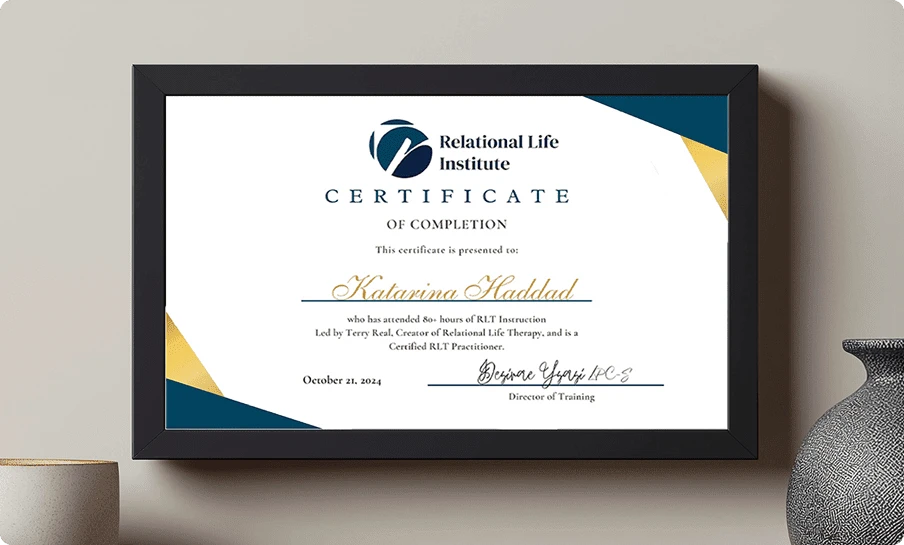
After successfully completing the certification requirements and Case Review, you receive a certificate of completion from the Relational Life Institute that recognizes your training in the RLT method.
Example certificate shown for illustration.
Professional clarity
The RLT Certified Relational Coach credential does not confer a mental-health license, authorize psychotherapy, or expand your legal scope. You remain responsible for your competence, insurance, contracts, and the laws and professional standards that apply to your location and role.
Relational Life Institute is an NBCC Approved Continuing Education Provider (ACEP No. 7495). Practicums 1 and 2 each currently provide 23 continuing education hours to certification students. Participants must confirm acceptance with their own board or jurisdiction. The complete certification is not an ICF-accredited program.
Frequently asked questions
A relationship coach helps clients understand recurring relational patterns, strengthen communication and boundaries, navigate conflict, and practice more effective ways of connecting. Coaching is not psychotherapy and does not include diagnosing or treating mental-health conditions.
Start by submitting the short application with your professional background and experience. The RLI enrollment team reviews your application and confirms whether the certification fits your background and goals. If accepted, you will be invited to a personal call to review the certification and your study path, followed by an invitation to enroll. You will then receive welcome information and access to begin onboarding and self-study.
The RLT pathway includes approximately 150 hours of learning and practice, RLT Levels 1–3, at least one approved Couples Experiential or Intensive, two 24-hour live practicums, six Small Group Mentoring sessions, access to appropriate real clients, and a faculty-reviewed Case Review. Live practicums and mentoring require full attendance.
The program is designed for professionals who coach clients across disciplines. You do not need a therapy license or a graduate degree in mental health. Applicants need appropriate access to real clients for practice, mentoring, and Case Review.
Potentially, when coaching is part of the person’s work and they can meet the real-client requirements within their professional scope. The credential does not expand anyone’s legal role or permit psychotherapy.
No. Previous couples experience can help, but it is not required. You do need regular access to appropriate real clients so you can integrate the method and complete your Case Review.
Yes. Passing with an individual client leads to Individuals Only; passing with a couple leads to Couples & Individuals. These are assessment outcomes within one pathway, not separate programs.
It uses a hybrid format: flexible, self-paced course content plus scheduled live practicums, mentoring, faculty calls, and support sessions.
The program includes approximately 150 hours of learning and practice. A typical planning range is 12–18 months, with 18 months of program access.
Your final Case Review includes one 30–40 minute recording or two 15–20 minute recordings of real-client work, plus a brief written case conceptualization. Faculty assess your use of the model, skills, presence, use of self, and reflective ability.
You need regular access to appropriate real clients. Friends, relatives, peers, and other students do not substitute for required client work. Informed client consent is required, and professional liability insurance is required by the final Case Review and listing stage.
Graduates retain lifetime access to the certification courses included in their enrollment and their selected elective. They also receive one free year in the separate RLI Alumni program.
No. The program leads to an RLT professional credential and should not be represented as an ICF-accredited certification.
RLI is an NBCC Approved Continuing Education Provider (ACEP No. 7495). Practicums 1 and 2 each currently provide 23 continuing education hours to certification students. Confirm acceptance with your own board or professional body.
Your next step
Explore the complete certification journey and discover how RLT can help you build greater confidence, clarity, and depth in your work with individuals and couples.
Enter your details to receive the RLT Certification brochure straight to your inbox.
By entering your email address you agree to receiving emails from Terry Real and the Relational Life Institute. You can unsubscribe at any time.