A New Course from the Relational Life Institute
Your Neurodivergent Clients Are Wired for Connection. Learn to Support Their Relationships With Greater Skill & Sensitivity
Join No Ordinary Love – the new 5-class course with RLI Trainer Caron Starobin, LCSW-C – and discover how to affirm differently wired brains while holding both partners accountable in your couples work.
100% Money-Back Guarantee

Featured In:




No Matter How Our Brains Are Wired, We Are All Wired for Connection

If you’ve ever sat with a couple where one partner said:
“When I’m trying to talk to my partner about something important to me,he doesn’t look me in the eye. I just don’t feel like I’m being heard, even though he says he’s listening.”
“I have a real need to be alone. It's not personal. It's just kind of essential otherwise I get overwhelmed. But my partner thinks I don’t want to spend time with them.”
"She went to the store to buy 5 things, 4 of them were for her, only one thing was something I needed. And that was the only thing she forgot. I feel like she just doesn't care about me."
"I know it looks to my partner as though I just don’t care enough to be on time. I really do try. I seem to misjudge how long each step will take, and once I realize I'm losing track, I end up feeling even more scattered..."
“I feel so lonely, I’m carrying the full weight of this relationship and I don’t think they even notice.”
There are scenarios we see every day in our sessions that could be read as inconsiderate, a lack of compassion, aloofness, coldness, disinterest… that actually could be pointing to a differently wired brain.

And when that happens, what do we do? What changes in our approach?
These are questions that overwhelm many practitioners – we may fear we’ll get it wrong or cause harm. We may think we need to learn an entirely new set of skills.
The good news is, we don’t need to become experts on neurodiversity to work in a more neurodiversity-minded way. Our job is not to diagnose, but to understand the nuances of neurodiversity and how it shows up in relationships.
When we do that, we can help our couples get their arms around their differences and start working together rather than blaming or shaming each other. And that’s exactly what you’ll learn inside our brand new course.
Introducing…
No Ordinary Love: Neurodiversity, Intimacy, and Relational Life Therapy
A five-class course with RLI Trainer Caron Starobin
No Ordinary Love isn’t diagnosis training, and you don’t need to completely change your approach to work mindfully with neurodiversity.
As Caron puts it, “we can do this and stay in the model of RLT.” You’ll build on the curiosity, humility, and accountability you already use and add in scaffolding and nuanced moves needed to affirm neurotypes in relationships.
Throughout this course, you’ll learn to become a “brain-to-brain and heart-to-heart translator”: gathering data with more nuance, doing deep work that honors each client’s neurotype, and teaching skills that come from an integrated brain state and make loving room for differences.
You’ll come away with the confidence, skill, and clarity you need to bring a neurodiversity-minded approach to your couples work while also expecting competence, accountability, and partnership in the relationship.
“It’s good for our biosphere to understand our neurosphere.”
— Caron Starobin, LCSW-C, RLI Trainer
Your No Ordinary Love Teacher
How This Training Will Help You
Over five 90-minute classes with RLT Trainer Caron Starobin, you’ll build a neurodiversity-minded way of working that stays fully inside the RLT model you already trust.
⭐ You’ll come away knowing how to:
1
See what's actually driving the pattern
Recognize the neurocognitive differences in processing, sensory experience, time, and empathy that sit beneath behavior you might otherwise read as aloof, cold, or a lack of compassion.
2
Recognize signals most trainings don’t teach
The long pause before an answer, the neutral affect, the “that’s simply not logical” expression, the request to lower the volume or dim the lights, the intensely precise speech and focus. Know how to work with these aspects, and when to refer for a comprehensive diagnosis.
3
Work with the intersection of relational trauma and autism
How to conceptualize family-system driven adaptations interacting with neurobiologically driven ones.
4
Make deep inner child work accessible, not overwhelming
Use pacing, silence, concretizing, and sensory-awareness to support neurodivergent clients in Phase 2 work.
5
Take shame and blame off the table
6
Add neurodiversity-specific scaffolding and micro-coaching to your work
Explore the Curriculum
Over five 90-minute classes with Caron Starobin, you’ll move through all three phases of RLT with a neurodiversity-minded lens – from data gathering, deep inner child work, and skills and repair.
Class 1
I'm Complicated and So Are You: Neurobiology as Context and the Neurodiversity Paradigm in RLT
Class 1 sets the stage for becoming neurodiversity-minded practitioners. We’ll recalibrate some of our uninformed thinking, misconceptions, judgements, and stereotypes that seep into our interactions with and hypotheses about clients.
We’ll explore:
- The core concepts every neurodiversity-minded practitioner needs – the Neurodiversity Paradigm, the four types of empathy, the Double Empathy Problem, neurotypical privilege, and why the language we use shapes how we think about our clients.
- How neurocognitive differences – in processing, attention, sensory experience, time, social and emotional reciprocity, and emotional regulation – quietly drive relational patterns.
- A real case example that shows how a neurodiversity-minded lens changes your hypothesis – moving away from pathologizing and toward curiosity, humility, accountability, and scaffolding, all while staying fully inside the RLT model.
- How guiding couples to name and understand neurobiological differences takes shame off the table and helps them hold each other in warm regard.
Class 2
A Deep Dive Into Autism: What Autism Is and Is Not, Co-Occurring Traits, Cultural Context, and Implications for RLT Practice
With Dr. Donna Henderson, Dr. Sarah Wayland, and Dr. Jamell White (co-authors of “Is This Autism? A Guide for Clinicians and Everyone Else”)
Through conversation with guest experts in autism, this class will increase our understanding of what autism is, co-occurring traits, cultural context and how to translate this information into our work with couples, individuals, and families.
We’ll explore:
- The neurobiological factors and features that inform the stories couples make up about each other.
- The Autistic Nervous System: identifying some of the actual brain differences and how they impact behavior, internal experiences, external experiences, and relationships.
- Co-Occurring Traits – for example, self-monitoring, working tempo, and aphantasia – and questions you might ask to deepen your understanding of your clients.
- Why Sensory Processing is fundamental to our work with Relational Mindfulness and RLT Phase 2, including the implications for conducting sensory-related work with autistic clients.
Class 3
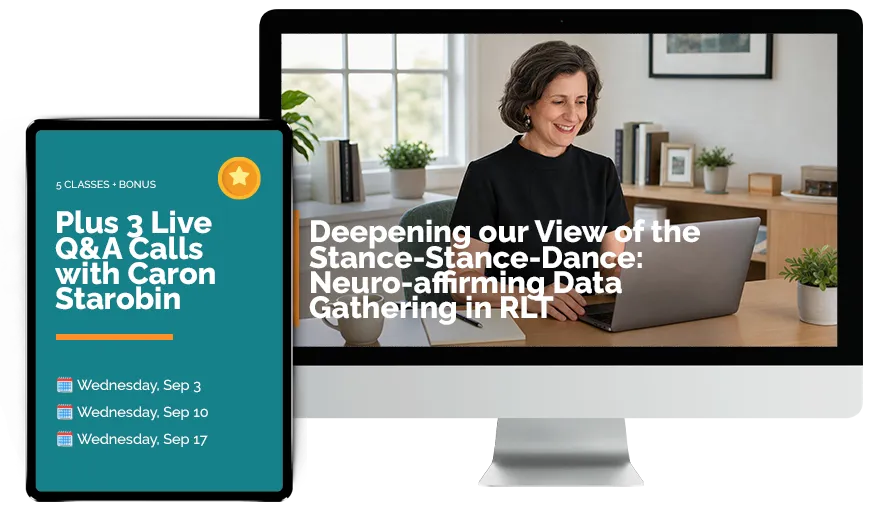
Deepening our View of the Stance-Stance-Dance: Neuro-affirming Data Gathering in RLT
We’ll consider how we gather data through the 8 lenses to arrive at the Stance-Stance-Dance, wake up the clients, and Join Through the Truth – all while integrating an awareness of differences in perception and processing.
We'll explore:
- How to integrate awareness of differences in perception and processing into your data-gathering with questions that aim for specificity and understanding of the dynamic.
- The intersection of relational trauma and autism: how to conceptualize family-system driven adaptations interacting with neurobiologically driven ones.
- How to name the differences you are noticing with curiosity, and understanding when to refer for a comprehensive diagnosis.
- How to provide “micro-scaffolding” in Phase 1 in service of monitoring for stress and safety while still holding clients accountable.
Class 4
RLT Phase 2: How Do We Honor Different Neurotypes in Deep Inner Work?
With a Phase 2 demonstration from Zariya Lufu (RLT Certified Therapist)
Class 4 takes us into Phase 2 – the deep, felt work of reaching into the histories that shaped who our clients became, working with the adaptive child, and cultivating Relational Mindfulness. We’ll consider how to guide clients to be in relationship with their Adaptive Child in a neurodiversity-minded way – including a recorded demonstration of this in action using psychodrama with Zariya Lufu.
We'll explore:
- What RLT Phase 2 is, through a neurodiversity-minded lens: guiding the client into relationship with their adaptive child in an embodied way that honors their neurotype.
- How neurobiology, social-cultural context, and multigenerational trauma influence the formation of relational trauma wounds.
- Interventions that help neurodivergent minds access Phase 2: slowing down, sensory sensitivity, concretizing, pausing, and silence.
- Experiential tools and why they land with neurodivergent minds, including psychodrama, doubling, and role play.
- How to lead with curiosity rather than analysis to support clients in trusting their own inner experience.
Class 5
RLT Phase 3: Building Skills and Facilitating Repair with Accountability, Curiosity, Scaffolding, and Micro-coaching
In our final class, we will look at how to teach couples the relational skills they can use in place of their losing strategies. We’ll name the key strategies neurodiversity-minded practitioners should reach for, and take a deep dive with Caron to closely examine excerpts of her work facilitating repair with a neurodiverse couple.
We'll explore:
- Tools with rules, scaffolding, and microcoaching: using clear visual cues and learning to assess for rigidity or too much flexibility: setting rigid thinkers up with ways to soften their edges, and helping infinitely flexible clients find ways to contain.
- How to become a Brain to Brain and Heart to Heart Translator in collaboration with clients.
- Navigating nervous system overwhelm as a partnership with compassion and accountability.
- The therapeutic stances that matter most here: skills transference, brokering and negotiating, constructing empowering reframes, and blocking and repositioning with finesse: staying internally and expressively fluid, direct with love, reconnecting clients to what they value and what they want.
- Why authenticity is especially important with neurodivergent minds and neurodiversity-affirming strategies for teaching skills for repair.
Bonus
Plus 3 Q&A Calls with Caron Starobin
About Your Teachers
Your Lead Teacher
Caron Starobin, LCSW-C, RLT Trainer
Caron Starobin, LCSW-C, has worked with autistic people and their families since 2001, and in recent years with neurodiverse couples. Her work is grounded in family systems thinking, RLT, and years of training with experts in neurodevelopment and autism.
A practicing clinician for more than 26 years, Caron owns Starobin Counseling, a group practice in the D.C. metro area. Her neurodiversity-affirming mindset has been evolving for over 20 years. She has studied RLT since 2018, is certified in the model, and became a trainer at the Relational Life Institute in 2024. She also trained intensively in Family Systems Theory in the Post Graduate Program at the Bowen Center in D.C. She has presented and consulted nationally on intimacy and neurodiverse relationships and on neurodiversity-affirming therapy.

Your Guest Teachers and Experts

Dr. Donna Henderson
Joining Class 2
About the teacher
Dr. Donna Henderson is a clinical neuropsychologist for over 30 years, specializing in evaluations for children, adolescents, and adults. She is a sought-after lecturer and provides training and consultation for other healthcare professionals.

Dr. Sarah Wayland
Joining Class 2
About the teacher
Dr. Sarah Wayland founded Guiding Exceptional Parents, a consulting and special needs navigation practice providing neurodiversity-affirmative support, education, and community for parents of neurodivergent children.

Dr. Jamell White
Joining Class 2
About the teacher
Dr. Jamell White has a background in clinical social work, special education, and human development and specializes in working with autistic children, adolescents and adults. She has over 20 years of clinical experience providing therapy, advocacy, and special needs navigation.

Zariya Lufu, RLT Certified Therapist
Joining Class 4
About the teacher
Zariya Lufu is certified as a Relational Life Therapist, RLT Relationship Skills Bootcamp Facilitator and Brainspotting Therapist specialising in trauma. She offers Intensives and RLT Relationship Skills Courses online worldwide. She has a Masters in Integral Theory, degree in Psychology, is trained in Attachment Family Focused Therapy and is currently doing a Masters in Psychodrama. Zariya is a late diagnosed autistic ADHDer, living with her two neurodivergent children in the UK.
What Your Peers Say About Neurodiversity, Caron Starobin, and Relational Life Therapy
“This information is invaluable and has helped me in real time with clients.
Please thank Caron Starobin, Terry, & the team for the amazing month of neurodivergent couple training 🙂 It’s been so personally validating as I’m autistic, a therapist trainee, and about 60-70% of my clients – both couples & individuals are ADHD/ASD/ or AuDHD.
This information is invaluable and has helped me in real time with clients as well as my own presence in the therapeutic settings. Thank you!”
— Jenny Rain
“I’m so thrilled that Terry proposed Caron teach a class on this.
Bravo on an excellent month of neuroscience-diversity training!! I’m so thrilled that Terry proposed you teach a class on this, you have so much to offer all of us! Many thanks Caron.”
— Gwen Petti
Who is this for?
This training is for you if you’re a therapist or coach who:
Is seeing more couples where one or both partners are autistic, ADHD, or otherwise neurodivergent – and you’d like to better support their relational work.
Has observed a client to be withdrawn or "aloof" in session, then wondered later whether there might have been something you missed.
Is neurodivergent yourself, and would like a way of working that honors how you and your clients are wired.
Please note: This course is a professional training designed to help practitioners work more mindfully with neurodiversity. If you are looking for help within your own relationship, we encourage you to browse our online courses and therapist directory for support.

🪶 A Letter from Terry
Practitioners are crying out for guidance on how the model they are so deeply committed to can be adapted to their neurodiverse clients. And the great news for all of us is that it absolutely can be. And I can think of no one better equipped than Caron Starobin to show us the way.
Caron is an exceptional RLT therapist and a member of the RLI training team responsible for training practitioners worldwide in the model. And she has spent more than 20 years developing a neurodiversity-affirming mindset. Her passion, commitment, and dedication has led her to find the adaptations, additions, and small pivots we can all make to our work while still staying true to the RLT model.
Like many of you, I never had any formal training in how to work with neurodiversity and much of what I have learned has come from my own clients over the years, and my own late-diagnosis of ADD. And let me tell you, once Belinda and I came to understand how my neurodiversity showed up in our relationship, it was profoundly eye-opening and transformative for us!
And through this course Caron will help you provide the support, scaffolding, and accountability you need to help your couples work together to embrace their differently wired brains.”
Warmly,
Terry Real
The Creator of Relational Life Therapy®
Enroll Today
No Ordinary Love: Neurodiversity, Intimacy, and Relational Life Therapy
Join the training with Caron Starobin – with guest experts and teachers – and learn to adapt your couples work for differently wired minds.
Here's everything you get:
- 5 90-minute classes with Caron Starobin
- 3 bonus Q&A calls with Caron
- A neurodiversity-minded framework you can apply across all three phases of RLT
- Practical handouts to help you integrate the material into your sessions.
- Lifetime access to all class recordings
- 100% money-back guarantee


You’re Protected by a 100% Money-Back Guarantee
We’re confident you’ll enjoy No Ordinary Love, but if for any reason you wish to withdraw from the course, you are entitled to a full refund within 48 hours. Please contact us at support@terryreal.com and we will issue you with a 100% refund, no questions asked.
Frequently Asked Questions
Do I need to be trained in Relational Life Therapy to take this course?
While some familiarity with the model and its 3 phases is encouraged, this training is open to non-RLT practitioners who are curious about how to adapt their couples work for neurodiverse clients. If you’re new to RLT, we recommend also exploring our on-demand RLT Level 1 course to build a solid foundation in RLT techniques.
Do I need to specialize in neurodiversity already?
Not at all. This course is for therapists and coaches who want to work more skillfully with neurodiverse couples – whether that’s a growing part of your caseload or something you’ve felt underprepared for.
Will this teach me to diagnose autism or ADHD?
No, this training is designed to help you understand and work with the nuances of neurodivergence rather than diagnose. You’ll learn to notice differences in perception and processing with curiosity and understand when to refer a client for a comprehensive diagnostic assessment.
I mostly work with individuals, not couples. Will this still help me?
Yes. The course is framed around couples work, but the neurobiological lens – how a person learns, processes, senses, and connects – applies directly to individual and family work too.
What if I'm neurodivergent myself?
You’re very welcome here, and the course is delivered with sensory-sensitivity and pacing to support your learning.
What's your refund policy?
You’re protected by a 100% money-back guarantee. If the course isn’t right for you, email support@terryreal.com within 48 hours and we’ll refund you in full, no questions asked.
I still have questions. Who do I contact?
Email us anytime at support@terryreal.com and we’ll be glad to help.