A Stronger, Calmer Partnership
Stay Steady When Your Partner Sets You Off – And Finally Break the Patterns Driving You Apart
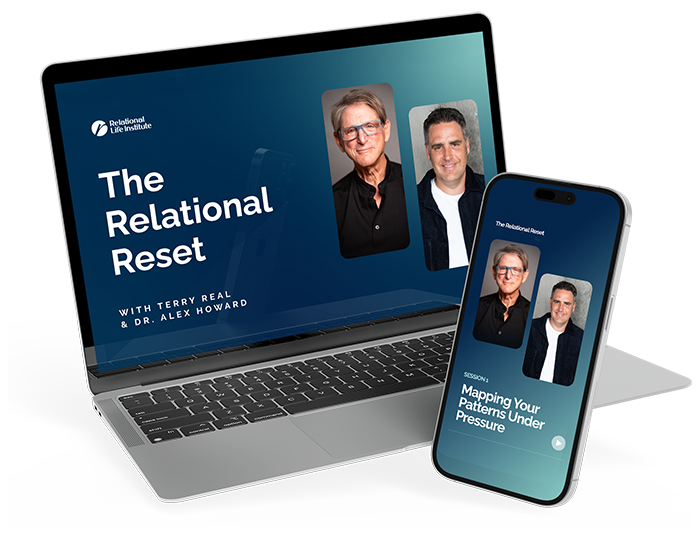
In this course, Terry Real and Dr. Alex Howard will help you master the practical tools to stay grounded in conflict – so you can actually use relational skills to repair in the moment and invite your partner into change. Even if you’re the only one doing the work.
100% Money-Back Guarantee

Terry Real
Terry Real has helped 100,000+ people learn the relational skills to build extraordinary relationships – with themselves and others.

Dr. Alex Howard
Alex Howard has helped 10,000+ people in 50+ countries heal from chronic stress, trauma, and the nervous system patterns that were running their lives.







You’ve Done the Inner Work… So Why Do You Keep Becoming Someone You Don't Want to Be

Your partner says or does that one thing and you feel yourself instantly leave the version of you who knows better. And you find yourself doing exactly what you swore you wouldn’t do again.
You snap at them, close yourself off. They don’t get it and you’re done having the same conversation.
And despite all your good intentions, you’ve been dragged right back into the fire…
You don’t want to get stuck in this same old cycle again, but you can’t help it.
And you’re left asking yourself…
Why can’t I just be different in this moment?

You know exactly the kind of patient, level-headed partner you want to be. You’ve pictured it and promised yourself you’ll give them that version of you.
What’s even more frustrating is that you can be that person. You’ve done the therapy, you’ve read the books. You’ve journaled, reflected, learned your patterns. You can stay calm with colleagues, friends, even strangers.
But somehow the person you love most still has the power to turn you into someone you barely recognize.
You know what to do, yet you feel like you have no ability to stop it. All your good intentions vanish at exactly the second you need them most.
And here’s what most people don’t talk about…
You’re doing more work on yourself than you ever have, and yet feel like your relationship is getting harder, not easier.

Even with all your attempts at getting your partner to change… all it ever seems to do is push them further away.
There may be a specific reason this keeps happening – and it has nothing to do with how hard you’ve tried or how much you care.
There’s a Reason Your Inner Work Isn’t Translating to Your Relationship
Trauma work can help you understand why you react.
But understanding why you react is different from knowing how to stay grounded while it’s happening.
Terry has spent more than forty years teaching the relational skills that help people repair, reconnect, and build healthier relationships.
Alex has spent his career helping people understand what happens inside the nervous system when those skills suddenly become unavailable.
Together, they answer a question neither approach can fully answer on its own:
How do you actually use what you know when you're triggered?
Terry and Alex have combined their expertise to help you do exactly that
First, Alex’s 5-step RESET framework: Recognize, Examine, Stop, Emotional Healing, Transform. The mechanism that bridges the gap between what you want to do, and what you actually do in the moment.
Then, Terry’s relational skills come in: 10-Step Time Outs, Feedback Wheel, fierce intimacy, and repair. The skills you already know – and what you’ll finally be able to use when it matters most.
Here’s how we get you there.
“For decades I’ve been saying relational mindfulness is the key. Take a break, get re-centered. But I rarely tell you how exactly. Alex Howard has spent his professional life perfecting a toolbox for precisely how to do that.”
– Terry Real
What You'll Walk Away With
Over seven 90-minute classes with Terry Real and Dr. Alex Howard, you’ll gain the self-regulating tools and relational skills to restore closeness – even in your toughest moments.
You’ll come away knowing how to:
1
Catch yourself before you act out.
Recognize the impulse rising in your body and interrupt the reaction before regret is necessary.
2
Understand your patterns in relationships.
Identify how you show up under stress – and what it costs you and your partner.
3
Stop fights in their tracks.
Recognize when you’re overwhelmed, and come back steady rather than fired up.
4
Ask for what you need and be heard.
Make requests that help your partner win, and invite the change you’ve been waiting for.
5
Repair disagreements without resentment.
Have hard conversations skillfully, and take in your partner’s efforts when they show up.
6
Invite more of what you want.
Change how you show up, and watch how your partner responds differently, more generously.
7
Make the changes stick.
Recognize old patterns when they return – and what to do to keep things from sliding back.
Available On Demand
You already know the partner you want to be – this course teaches you how to actually be them when it matters.
Not ready yet? The full class breakdown is just below.
Your Seven-Class Transformation
All seven classes are recorded and yours to keep forever.
Class 1
When You've Done the Work but Your Relationship Is Stalling
Understand why insight and trauma work can disappear under relational pressure—and how nervous-system regulation and relational skills work together.
You’ll learn:
- Recognize fight, flight, freeze and fawn as adaptive-child responses
- Map the sequence from activation and automatic reaction toward pause and choice
- Connect regulation with boundaries, empathy, repair and accountability.
Class 2
Mapping Your Patterns Under Pressure
You know you lose it, but you don’t always know what’s behind the reaction. We’ll map exactly what happens to you when things get tense, so you can see the pattern and begin to change it.
You’ll learn:
- How you respond to stress in your relationship – whether you fight, flight, or fawn, and how each pulls you out of connection.
- Your levels of self-esteem and boundaries – and how the two combine to shape your behavior under pressure.
- What it takes to get recentered in the part of you that wants to make things better – by discovering the core practice of relational mindfulness.
- Your triggers to losing connection – using a practical framework to decode your nervous system throughout the day.
Class 3
Resetting Your Nervous System and Staying Grounded
Now you know your pattern, this is where you’ll be able to catch it before it reaches your relationship. This class gives you a practical toolkit to use in the moment with your partner.
You’ll learn:
- How to break bad habits – using the Stop Process that allows you to build new, healthy patterns that last.
- What to do when you recognize old patterns returning – and how to catch yourself using relational mindfulness techniques.
- Ways to ground yourself, even when your partner triggers you – through practical regulation tools you can use everyday and in your relationship’s toughest moments.
- How to work with your inner critic – by showing it compassion and training it, rather than allowing it to drive you during conflict.
Class 4
Breaking the Cycle in the Heat of Conflict
When you’re overwhelmed, conversations easily escalate – and skills fly out the window. This class is built around that moment and what to actually do when you’re there.
You’ll learn:
- Physical signs you’ve crossed into overwhelm – so you recognize the “whoosh” and know your next steps forward.
- How to give yourself time to calm down and recenter – by using the 10-Step Time Out tool to take distance from your partner responsibly.
- The steps to come back into the relationship – following the Presence Process to reconnect to your body and ground yourself.
- What healthy self-esteem looks like in practice – and the 6 common emotional defenses that may be keeping you stuck in conflict.
Class 5
Inviting the Change You Want
The way you’ve been asking for change may be the very thing stopping it from happening. Class 5 is how you ask in a way that actually helps your partner win.
You’ll learn:
- How to stop treating each other like opponents – and start working as a team again by moving from “you vs. me” to “us”.
- Why you may be making it harder for your partner to say yes – and the importance of shifting from complaint to request.
- The 3 steps to getting what you want – including how to invite generosity, help your partner win, and make it worth their while.
- How to invite your partner to change – without forcing, pressuring, or becoming their teacher.
Class 6
Remembering Love
You know how to fight, but do you know how to close it? Discover how to repair, come back together, and receive them when they finally show up.
You’ll learn:
- Why healthy conflict actually strengthens a relationship – when handled well using The Repair Process.
- How to handle the conversations you’d rather avoid – using transmission–reception and the step-by-step Feedback Wheel framework to speak skillfully and listen well.
- How to say sorry and make it count – by following the 4-Step Apology that your partner can actually receive.
- How to grow more of what you want – by opening up and receiving what your partner starts giving you.
- The importance of letting go of the outcome – and maintaining focus on improving your side of the street.
Class 7
Making the Changes Last
You’ve made changes to your relationship, now it’s time to make them last. Class 7 covers the daily practices that keep things from sliding back – and what to do if old patterns resurface.
You’ll learn:
- Ways to create a cherishing relationship – through daily practices that help you appreciate what you value in your partner.
- How to develop your gratitude – and the power of celebrating the glass being 15% fuller than it was yesterday.
- Recognizing your old patterns as they return – and knowing exactly what to do when they do.
Tools to Return To
Guided Practices
- Stop Process: interrupt an automatic reaction and return to your body.
- Inner Child Process: offer steadiness and non-abandonment to the younger parts of you.
- Presence Process and Forgiveness vs. Forgetting: reconnect with present-moment awareness and separate forgiveness from restored trust or relaxed boundaries.
Practical Relationship Tools
- 10 New Rules for Taking a Time Out
- Five Winning Strategies
- Four-Step Apology
This Course Is For You If…
You’ve read the books, done the therapy – and it helped
but you still lose it the moment your partner pushes your buttons.
You can stay regulated alone through meditation, breathwork, and journaling
but the moment things get charged with your partner, all of it goes out the window.
You're committed to growing as a person
and at the same time, you feel like you and your partner are quietly growing apart.
You keep trying to get your partner to do the work with you
always explaining, pushing, hoping – and it keeps backfiring.
You’re not sure who’s more at fault
you just know the same fights keep happening – and you can’t seem to stop them.
You want to be the kind of partner who shows up steady when it counts
not the version of you who shows up when you’re thrown into the fire.
Meet Your Teachers
Terry Real and Dr. Alex Howard both come from different fields – and each holds the missing piece they see their clients needing. One built the regulation tools to stay grounded under pressure, while the other built the relational tools that transform life’s most important relationships.
This course is the first time both pieces are being taught together to bridge the gap between you and the relationship you deserve.
Terry Real
Founder, Relational Life Institute
Terry Real is a family therapist who grew up in a violent, dysfunctional family – and spent the next forty years figuring out how love gets broken and repaired.
That work started in his own marriage. He and his wife, Belinda, have been together for over four decades, and Terry will be the first to tell you he’s been the problem more than once.
As a New York Times bestselling author and creator of Relational Life Therapy (RLT), Terry has now trained thousands of therapists across the world to carry forward his work.
Terry didn’t get here by helping people repeat years of traditional therapy. He built it from the wreckage of his own childhood, the near-misses in his own marriage, and decades of sitting with couples on the brink.
He’s made the mistakes, he’s done the repair. And after forty years, he still believes the relationship can be saved. Most of the time, he’s right.





Dr. Alex Howard
Founder, The Optimum Health Clinic
Alex Howard, married with three daughters, spent his teen years suffering from a severe chronic illness with no mainstream treatment available.
Over the next 5 years, Alex went on a transformational journey back to physical health and emotional healing, and dedicated his life to helping others to do the same.
That commitment became The Optimum Health Clinic, three books, including It’s Not Your Fault, and his Super Conference series that has drawn over 1 million attendees.
His professional training program, Therapeutic Coaching™, was built around one question: once you understand what’s happening inside the nervous system, how exactly do you change it?
Having helped over 10,000 people find that answer, he saw one gap in his clients remaining. They know how to regulate their nervous system and stay grounded – but their relationships were remaining the same… sometimes they were getting worse.
That’s what led Alex and Terry to come together, to apply these self-regulation tools, for the first time, directly to what happens inside a relationship when you have the skills to transform it.
Published in BMJ Open and Psychology and Health
Endorsed by Dr. Rick Hanson · Dr. Peter Levine · Judith Orloff MD
Clients
Countries
What People Say About Terry and Alex

“This gave me what I would call the skills for daily living.
I saw a dramatic change – the capacity to interrupt myself … and know that’s all I’m responsible for. That just changed everything.
For me, because some of these things are so deeply rooted—I’m 62—I need practice and interaction. I was surprised at how emotional I got.
This gave me what I would call the skills for daily living … It was the homework that was going to create the personal transformation.”
Cathy Breunig for Terry,
Living Love Group Coaching participant
“A transformative and life-changing impact on me.
The RESET program has been a brilliant way for me to learn and put into practice a variety of tools/techniques to help with calming my nervous system. I have experienced a number of changes (including working on defending against my inner critic and opening up to my emotions) that have already started to make a transformative and life-changing impact on me.
With Alex’s skillful, supportive and enjoyable way of teaching, I would thoroughly recommend to others.”
Simon,
RESET program participant
“So liberating for me when I realize that I am the one who can change.
I loved Terry’s emphasis that you can only change yourself, not your partner. It’s so easy to fall into the trap and yet so liberating for me when I realize that I am the one who can change.
I now understand how my journey towards healthy self esteem has provided me with the perfect foundation to become a loving partner and to create the intimate relationship I have always desired. I am really excited about our future together and look forward to learning more!”
Elaine Van Melle,
Getting What You Want From Your Relationships participant
“I now feel I have ways to safeguard myself and act differently.
After years of trying so many other responses to my issues and struggles, I finally found something that worked for me! The practical tools have been invaluable. I wish I had come across them years ago.
In situations that formerly seemed completely outside my control, I now feel I have ways to approach, to safeguard myself and to act differently.”
Kath,
RESET program participant
Frequently Asked Questions
I’ve tried therapy and trauma work before. Why would this be different?
Trauma work is built to help you understand your patterns and heal deep pain – and it often creates real change internally. This course teaches what trauma work isn’t designed to do: bring that change into your relationships.
So it’s not a replacement for the work you’ve already done. It’s what allows that work to finally show up where it counts – between you and the people you love.
My partner doesn’t want to join. Can I come alone?
Absolutely. This course is designed to help you shift the dynamic between you and your partner by changing how you show up. While it’s wonderful if you choose to come as a couple, you’ll learn self-regulation tools and relational skills that will invite your partner into change – even if you’re the only one doing the work.
Do I need to be in a relationship to join?
No. The patterns this course addresses – how you respond under relational pressure and how you move from reaction back to connection – show up in every significant relationship in your life. What you’ll learn applies to romantic relationships, but also family, friends, colleagues, and even your relationship with yourself.
How do I access the course?
All seven classes are recorded and available on the private learning platform. You’ll have lifetime access, so you can watch at your own pace and return to anything you want to revisit.
What is your refund policy?
You have a 100% money-back guarantee. We’re confident you’ll love this course with Terry and Alex, but if you change your mind for any reason, you have 48 hours after purchase. If within 48 hours you decide it’s not right for you, contact us at support@terryreal.com and we’ll send you a full refund. No questions asked.
Is $295 fair for a seven-class course with Terry and Alex?
We’ll let you make that call. A single session with a couples therapist in most US cities runs $200–$350. This is seven 90-minute classes, lifetime recordings, and instruction from two practitioners who don’t often teach together. The payment plan option – two payments of $165 – is there if the full amount isn’t the right fit right now.
I still have questions. Who should I speak to?
Please reach out to support@terryreal.com and we’ll get back to you as soon as we can.
Become the Partner You Know You Want To Be – Especially When It’s Hard
However much inner work you’ve done up until now, this course is where you put insight into action – and start handling your relationship’s toughest moments with steadiness and skill.
If this isn’t right for you, we’ll refund you, no questions asked.
48-hour money-back guarantee from purchase.
By the end of the course, you won’t just know better – you’ll be able to stay grounded, respond differently, and change what happens between you.
Includes lifetime access to all class recordings.